California has made an unprecedented investment in community schools, which often include four evidence-informed programmatic features that are aligned and integrated into high-quality, rigorous teaching and learning practices and environments:
- Integrated support services;
- Family and community engagement;
- Collaborative leadership and practices for educators and administrators; and
- Extended learning time and opportunities.
Since 2021, the state has invested more than $4 billion to expand community schools designed to better support the whole child. Early research from the Learning Policy Institute shows meaningful reductions in chronic absenteeism and suspensions, along with gains in academic achievement, particularly for historically underserved students.
These investments matter because learning doesn’t happen in isolation. Young people need to feel known, connected, healthy, and supported. Families need trusted relationships with schools. Educators need partners who can help address the many factors that shape a student’s ability to learn.
But creating better conditions around learners is only part of the opportunity. We also have to ask what happens when students walk into the classroom.
In many schools, even as wraparound supports, partnerships, and expanded learning opportunities have grown, the instructional core remains largely unchanged. Students still move through departmentalized schedules, courses, assignments, and assessments that were designed for a different era.
Read More: Knowing What to Measure and When During Your Redesign Journey
Interestingly, California’s community schools research points directly to this challenge. While middle and high schools experienced meaningful reductions in suspensions, improvements in attendance and achievement were less consistent. Researchers note that traditional departmentalized structures can make it harder to build the close relationships among students, educators, and families that community schools are designed to foster.
This is where California’s investment in secondary school redesign becomes so important.
The Secondary School Redesign Pilot is focused on ensuring every student is known and supported, creating deeper and more relevant learning, personalizing supports, increasing engagement, and building sustainable structures that can maintain impact over time.
Community Schools and Secondary School Redesign are complementary parts of a learner-centered ecosystem.
Connecting the Ecosystem
In our Learner-Centered Ecosystem framework, evolution requires alignment across five interconnected elements: Whole-Learner Outcomes, Learning Model, School Design, Enabling Conditions, and Culture.
Community schools have made significant investments in the enabling conditions young people need to thrive: relationships with families, integrated supports, community partnerships, expanded learning opportunities, and connections to resources beyond school walls. These partnerships can break down barriers, expand access, and enrich learning.
Secondary redesign creates an opportunity to connect those conditions more intentionally to the Learning Model and School Design.
It’s good that we are asking, what additional supports do students need? But we also need to ask: How should school itself be designed so young people experience belonging, agency, challenge, purpose, and connection every day?
That might mean advisory structures where every learner is deeply known. Flexible schedules that create time for internships and community-based projects. Interdisciplinary learning connected to real problems. Performance assessments that allow students to demonstrate what they know and can do. Teacher collaboration structures that allow educators to design around learners rather than isolated courses.
Read More: Beyond the Classroom: Cultivating Local Partnerships to Generate Real-World Learning Opportunities
Across Learner-Centered Collaborative’s Secondary School Redesign Network, we are already seeing bright spots that demonstrate what becomes possible when these strategies begin to work together.
In Vista Unified, the district’s secondary redesign efforts illustrate how schools can build from the assets and opportunities already present in their communities while redesigning structures and learning experiences around young people. Rather than treating partnerships, learner supports, and instructional redesign as separate initiatives, the work creates opportunities to connect them around a more coherent vision for learners.
At Madison High School, teacher-led Communities of Practice are creating the professional conditions educators need to redesign learning. Teachers are learning with and from one another, strengthening PLCs, testing new approaches, and building their collective capacity to create more meaningful experiences for students. This is an important reminder that redesign isn’t only about changing the student experience—it requires redesigning how adults learn, collaborate, and lead as well.
Read More: Building a Learner-Centered Culture for Educators
At Lincoln High School, a strong community school model is becoming a foundation for expanding what learning can look like. By listening to learners and understanding their needs and aspirations, leaders saw an opportunity to reimagine how students spend their time during the school day. Through a new microschool model, students can participate in paid internships that connect their learning to workplaces, mentors, and opportunities beyond the school walls.
Rather than treating community partnerships as supports that sit alongside academics, Lincoln is beginning to integrate those assets into the learning experience itself. The same relationships and resources that help students thrive can also expand what, where, and with whom they learn—connecting young people to authentic experiences, stronger networks, and possible futures.
These examples begin to blur the lines between what we might call “community schools” and “school redesign.” And that is exactly the point.
The opportunity isn’t to layer one initiative on top of another. It is to connect them.
The Opportunity Is Coherence
Imagine a student who has access to a counselor, health services, mentors, and family supports—and also belongs to a small advisory community where an adult knows their goals and strengths.
Imagine community partners who don’t just provide services after school, but become partners in learning—hosting internships, posing authentic challenges, mentoring projects, and providing feedback on student work.
Imagine a school where teachers have the time, structures, and professional community to learn together and redesign experiences around what their students need.
Imagine schedules, staffing, assessment, professional learning, partnerships, and resources all reinforcing the same vision for what we want young people to know, become, and be able to do.
We can already see pieces of this future emerging: in Vista’s redesign efforts, in Madison’s teacher-led Communities of Practice, in Lincoln’s community partnerships and paid internships, and in schools across California that are finding ways to connect supports, relationships, learning, and opportunity.
That is the shift from a collection of good programs to a learner-centered ecosystem.
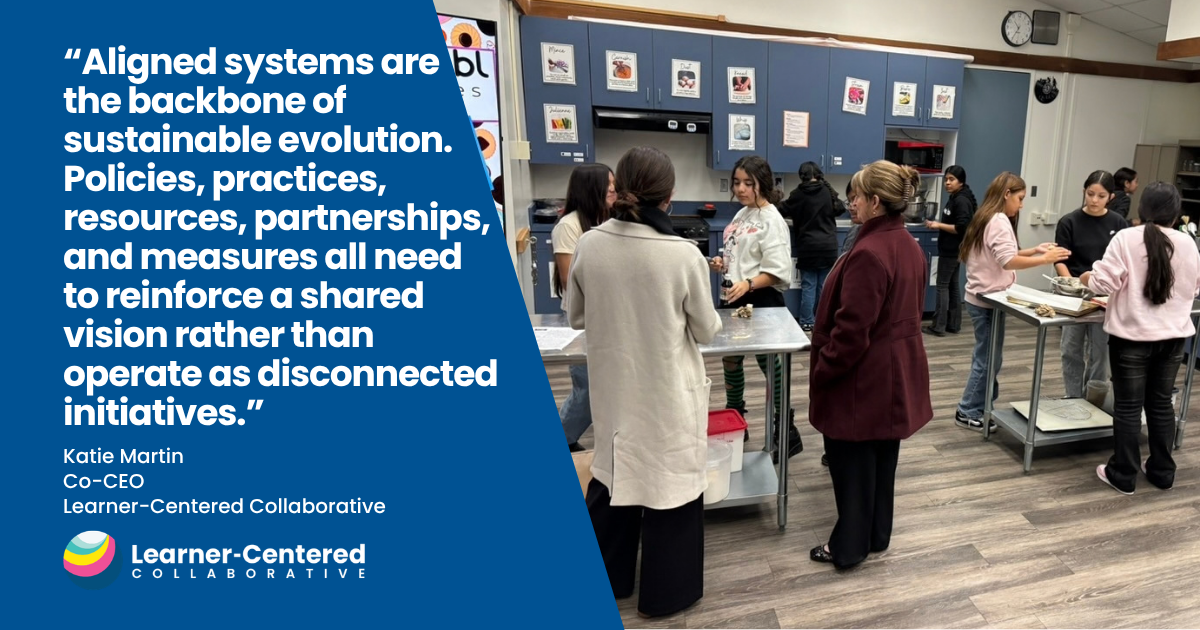
Our ecosystem framework argues that aligned systems are the backbone of sustainable evolution. Policies, practices, resources, partnerships, and measures all need to reinforce a shared vision rather than operate as disconnected initiatives.
California has invested significantly in both community schools and secondary redesign. The opportunity now is not to create parallel efforts, but to connect them around a shared vision for young people.
California doesn’t need to choose between supporting students and redesigning school.
Community schools can strengthen the relationships, partnerships, and conditions around learners. Secondary redesign can help transform the structures and learning experiences at the heart of school. And, increasingly, the same people, partnerships, and structures can do both.
Together, they create the opportunity to build learner-centered ecosystems in which every young person is known, supported, challenged, connected, and empowered to thrive.
Seeing the possibilities of what a learner-centered ecosystem might bring to the learners you serve can be exciting and overwhelming at the same time. To move from vision to implementation, it helps to know where your school or district is at today and what the next best steps might be. Take our Learner-Centered Ecosystem Self-Reflection to discover your next steps.