Knowing What to Measure and When During Your Redesign Journey
Nine marathons, an Adidas sponsorship, and torchbearer for the 2012 Summer Olympics. That’s Fauja Singh’s story, and none of it occurred before his 89th birthday.
Five years earlier, at 84 years old, Singh was in deep grief, processing the losses of his wife and two of his children over the span of just a few years. Shortly after his son’s death, he moved to London, where he saw a group of elderly Indian men running in the city. Curious, he asked to join the group. Running a marathon wasn’t the original goal. Singh just wanted a sense of community and an activity to help him heal.
I find Singh’s story to be instructive for schools and districts embarking on significant change efforts. If Singh initially set his mind on running a marathon (and breaking other running records), he may have given up the pursuit well before he set foot on the starting line. It took five years from the time he began running to entering his first race. Without realistic goals in between, what would have kept him going?
This tension shows up constantly in the redesign work we do at Learner-Centered Collaborative. Let’s say a grant funds a two-year window of work and the primary redesign goal is for every child to graduate knowing who they are and where they want to go next in their studies or what their first career move will be.
That’s a five- or 10-year goal at best. Achieving it in two years is simply not possible.
Of course, that’s not an argument for lowering the bar. It’s an argument for knowing what to look for along the way and establishing the right expectations for the funding window. Identifying these in-between goals likely kept Singh moving long before marathon day ever arrived, and it’ll keep a learning community’s work energizing throughout the change process.
Revisiting the Tiers of Data Framework
I have written before about the value of looking at success across tiers of data rather than reaching straight for outcome measures, and it is worth applying that same framework here, because it answers the question Singh’s story raises. What do we measure and when?

Activity metrics come first. Is the new practice happening? Are people showing up?
Feedback metrics come next. How are students, families, and educators experiencing the changes? What stories are showing up for them?
Observation metrics follow. What are the visible but still early signs that something is shifting in how educators and learners experience learning?
Impact metrics sit at the top and get us to the ultimate outcomes of the work. Do graduates know themselves? Are they walking away with a job offer or a college acceptance already in hand?
For years, the only evidence that Singh’s routine was working was that he kept showing up (activity metric). Then, he began working with a running coach (feedback metric). As his training improved and Singh officially committed to running his first marathon, the coach noticed Singh began training more seriously, he had more energy, and he was getting better sleep (observation metric). Then, in 2000, he ran his first marathon in just under seven hours (impact metric).
How This is Showing Up in Practice
I recently watched this framework click for a group of school board members in a workshop with Winters Joint Unified School District in California. They were rolling out a new capstone experience at the high school, and the moment we walked through the tiers together, you could see them making connections with measures that align with implementation. Their job in year one is to monitor if students are engaging with the capstone and how they are responding to it. That’s it. Nothing about performance or test scores or graduation rates yet. Those metrics will come later.
Read More: Measuring What Matters to Enable Meaningful Learner-Centered Change in Your School or District
Importantly, a single outcome might require different tiers of data. As I previously explored: “In Northern Cass, one of their outcomes includes “empowering educators to engage in innovative practices.” To measure progress toward that outcome, they are tracking educator retention and participation in professional exhibitions (activity metric), conducting culture surveys (feedback metric), and looking for five specific bright spots within classroom settings (observation metric).” You can see Northern Cass’s scorecard here.
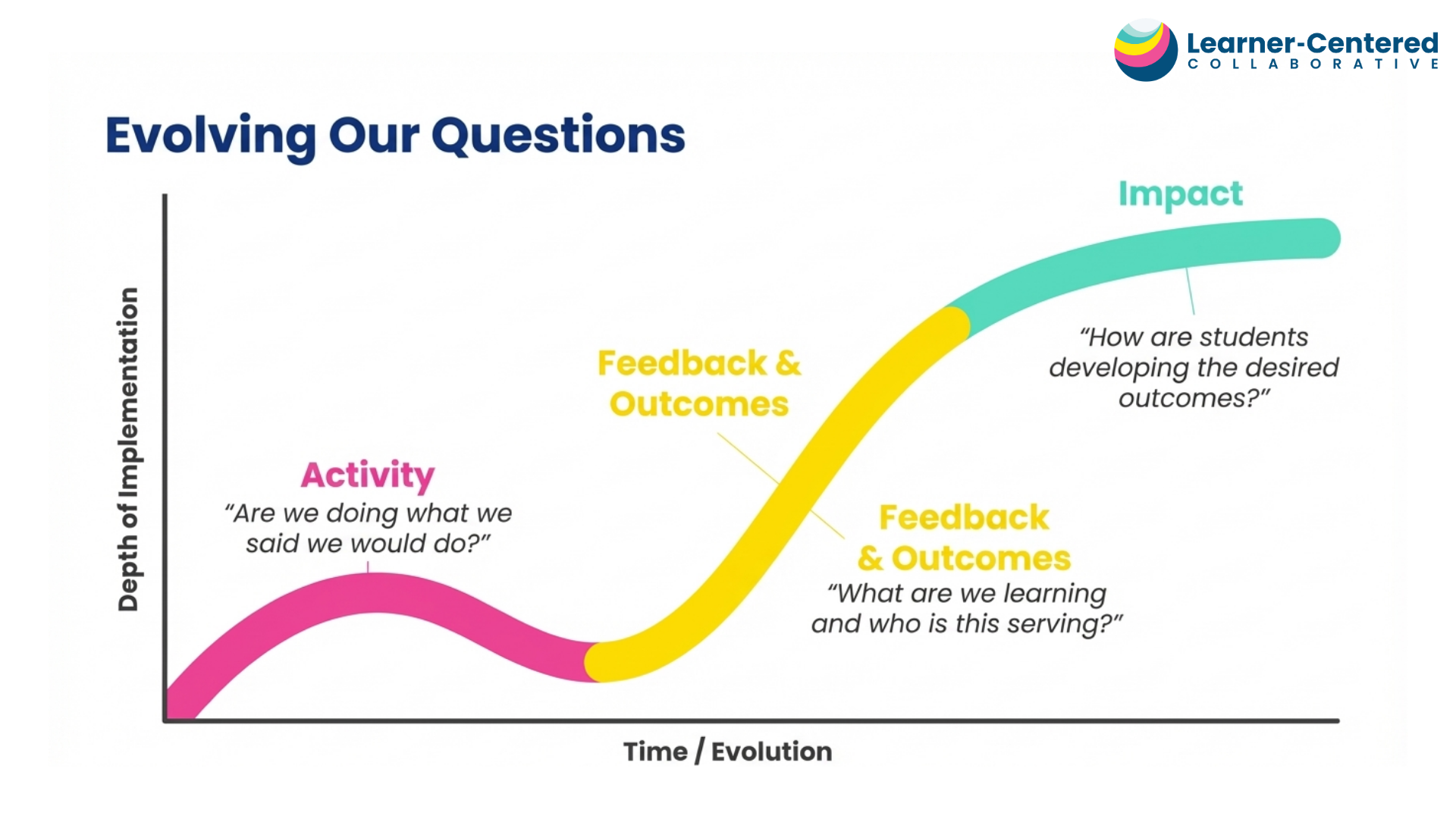
Winters and Northern Cass are applying the same framework in two different ways. Winters is watching a single new practice mature tier by tier over the course of a school year. Northern Cass is triangulating one complex outcome across three tiers at once; activity, feedback, and observation data all aimed at the same target from different angles. Both approaches are telling leaders and their communities whether real progress is happening toward their goals.
The Tiers Invite New Thinking Around Accountability Metrics
Committing to activity and feedback metrics early on invites something new that may not have initially been present. The metrics accountability systems already track (e.g., grades, graduation rates, seat time) are not always the same as the metrics employers, universities, and families say actually matter most (e.g., durable skills, whole learner outcomes). Leaning into activity and feedback metrics gives leaders an honest, defensible way to show progress while the harder work of realigning what gets measured long-term continues alongside it.
Read More: What is the Purpose of School? A Call for Whole-Learner Outcomes.
Creating a Five-Year Runway Everyone Believes In
Every learning community embracing meaningful redesign is running its own version of Singh’s five years, showing up long before the ultimate outcome can be measured. Knowing what can be measured in-between, the early signals that map to the long-term outcome, is what matters most. Prioritize activity and feedback metrics in the early stages of a change effort. Then, integrate more and more observation data as practices become established and momentum and belief in the work builds.
Seeing early wins builds the momentum learner-centered change depends on. When we only monitor metrics that won’t meaningfully change in the short-term, we run the risk of expecting them to move faster than they realistically can and miss real signs of progress that sustain the work. Get the indicators right, and you hand your work the same runway that turned an untrained 84-year-old into an Olympic torchbearer.
At Learner-Centered Collaborative, we support schools and districts with co-designing learner-centered strategies, building the measurement systems that match each stage of the journey, and helping leaders tell an honest story about progress. Ready to see how we can support you and your learning community? Connect with us here.