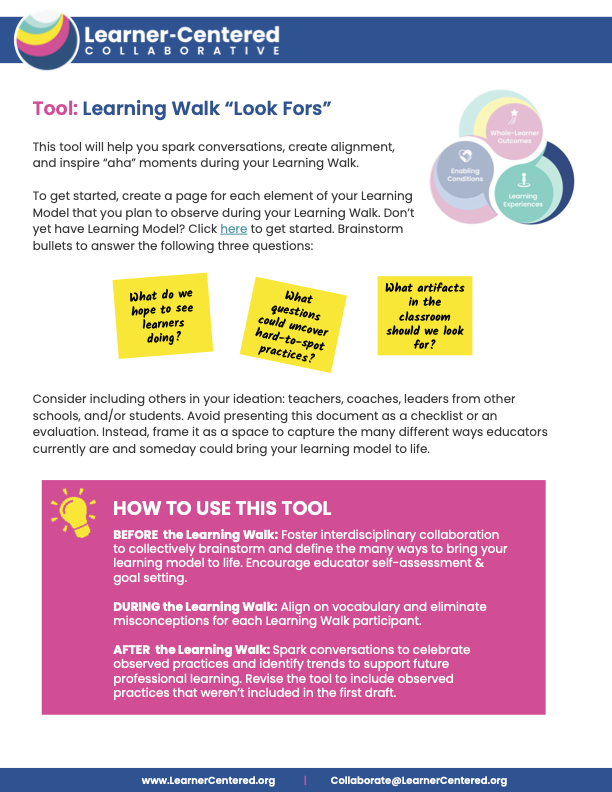
Learning Walk “Look Fors”
As the name implies, Learning Walks are an opportunity for learning. Using a school or district’s Learning Model as an anchor, Learning Walks bring us beyond our own classrooms and schools to observe learner-centered practices and bright spots in classroom environments, celebrate strengths, and identify trends to inform future support—all in a non-evaluative way.
Learning Walks are a signature learner-centered practice — one of our favorites at Learner-Centered Collaborative. They provide an opportunity to view learning in a classroom without an evaluation or judgment mindset. Visiting classrooms to see learning in action is not only a best practice, but also critical to a learner-centered approach. Observing learning puts learners at the center, which enables schools to celebrate meaningful learning experiences and create the enabling conditions to support them.
This tool serves as a guide for Learning Walks. It is designed to be completed collaboratively before Learning Walks to gain alignment on “look fors” and language among team members and can serve as an outline to frame reflection discussions during and after Learning Walks.
To download the tool, please complete the form below:
Why conduct Learning Walks?
This exercise offers an authentic glimpse into teaching and learning practices in a school or district. A few minutes of observation rarely tells the full story of learning in a classroom, but the snapshot is often just enough to begin celebrating bright spots and identifying trends, allowing us to:
- spot best practices to celebrate with educators,
- create shared understanding of learner-centered strategies in practice,
- connect with learners to better understand their school experience,
- discover opportunities for future professional learning, and
- uncover conditions that are enabling or blocking a learner-centered approach