Public Microschools as an On-Ramp to Systemic School Redesign
 The idea of microschools is generating growing interest across the education landscape. They’re showing up more frequently in philanthropic conversations, conference sessions, and learner-centered education spaces as leaders look for new ways to respond to longstanding challenges and emerging opportunities.
For school and district leaders, this rising interest can feel irrelevant to their local contexts. Are microschools applicable to a public school district? What kind of staffing capacity is needed to get them going? How do I communicate to families what a microschool is and get them excited about having their children participate? And, perhaps most importantly, are microschools actually a threat to public education?
Having worked within public microschools as a principal, overseeing them as a superintendent, and now supporting district partners with our team here at Learner-Centered Collaborative, under the right conditions, microschools strengthen public education instead of fragmenting it.
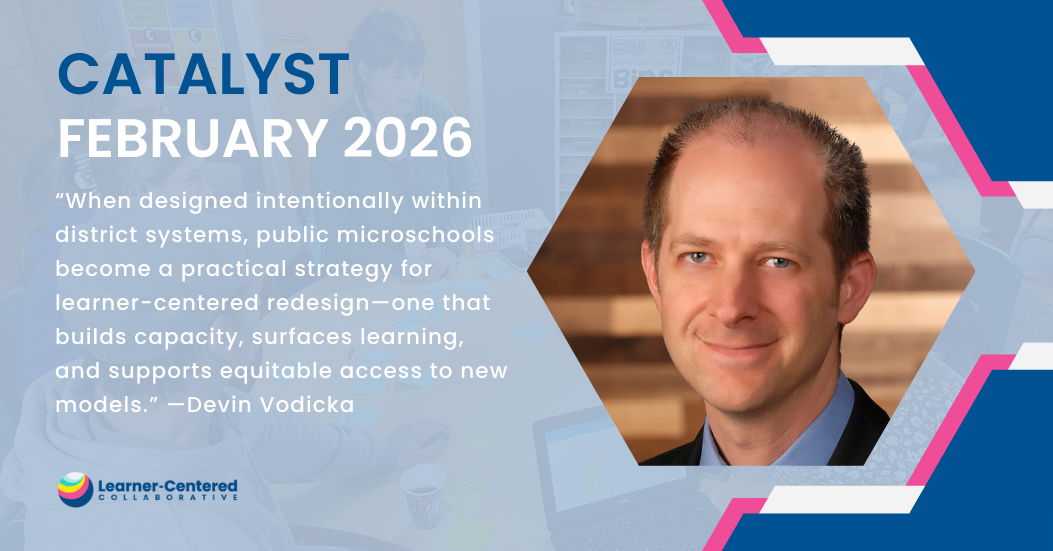
When designed intentionally within district systems, public microschools become a practical strategy for learner-centered redesign—one that builds capacity, surfaces learning, and supports equitable access to new models.
What Do We Mean by a Public Microschool?
At its core, a microschool is not just a classroom experimenting with new practices. It is a distinct learning community, typically:
- 50–150 learners
- Teams of educators working together
- Operating in a self-contained structure for at least part of the day
- Granting flexibility over schedules, staffing, and learning design
What elevates a microschool beyond pilot initiatives is the container it creates. Within that container, educators aren’t only designing learning experiences—they are designing systems. Bell schedules, use of time, grouping of learners, and enabling conditions are all reimagined together.
It’s important to note that public microschools do not require significant new resources to launch. Their greatest advantage is that they build on what already exists. Public microschools leverage current facilities, staffing, transportation, and student supports, shifting the focus from acquiring new inputs to reimagining how time, people, and structures are organized. Rather than asking districts to do more, microschools invite leaders to do things differently—unlocking flexibility and innovation within the infrastructure they already have in place.
Why Microschools and Why Now?
Interest in microschools is accelerating for several reasons:
- Policy shifts in some states are making alternative models more visible
- Family demand for more personalized, human-centered learning is growing
- Technology and AI are increasingly accessible, changing what’s possible at scale
These forces can either push education toward further fragmentation and privatization—or they can become a catalyst to revitalize public education from within.
That distinction matters.
When microschools exist outside of public systems, innovation risks becoming a privilege. When they are embedded within districts, they can increase access to new learning models while strengthening the system as a whole.
Learning from Charters and the Small Schools Movement
It’s fair to ask: Isn’t this what charter schools or the small schools movement were supposed to do?
In theory, yes. In practice, we learned some hard lessons:
- Charters became “othered.” Designed to operate apart from districts, they often created competition instead of collaboration.
- Innovation didn’t spread. There were few mechanisms for cross-learning or scaling what worked. They were not set up as a dual operating model.
- Schools were treated as the unit of change, rather than part of a larger system.
Microschools inside districts offer a chance to do this differently by treating innovation as something to be tested, learned from, and integrated, not isolated.
Microschools Can Catalyze Systemic Change
Microschools are not the end goal. They are a strategy for change management.
They allow leaders to:
- De-risk innovation by shrinking the unit of change
- Start with opt-in educators and families
- Test new schedules, staffing models, and learner supports
- Learn quickly before scaling what works
Escondido Union School District is a great example of how microschools have functioned in service to the district, piloting new approaches to wellness, advisory, and scheduling that have begun scaling across the district.
The success story of any microschool should be this: what begins as a microschool disappears because its best practices become the new normal across the district.
What This Means for District Leaders
Launching microschools requires courage. It involves:
- Letting go of centralized control
- Trusting educators as system designers
- Creating permission structures for innovation
Importantly, however, it does not require an entire school to do it at the same time, hence the “micro” part of microschools. It’s a small cohort within a school, offering space to take big swings with minimal risk. Again, once an idea works, then it can be confidently scaled school- and eventually district-wide.
How Learner-Centered Collaborative Can Help
This work is not theoretical for us.
Through partnerships with districts in California, Hawaii, and Virginia—and through emerging regional networks of public microschools—we have supported more public microschool launches than almost anyone in the country.
Our role is to help districts:
- Align microschools to a learner-centered vision
- Design enabling conditions, not just programs
- Learn from early pilots and scale with coherence
- Onboard the broader community from day one, and help communicate progress
If you’re exploring microschools as part of your learner-centered strategy, we’d love to partner with you.
Now is the moment to lead change. Embracing microschools within public systems is one powerful way to begin.