Why School Systems Need Embedded R&D to Evolve
Across the country, we’re confronting a reality we can no longer ignore: our current education system isn’t meeting the needs of today’s learners—or the expectations of their families, communities, or future employers. Disengagement is rising. Teachers feel increasingly constrained by mandates that don’t reflect the day-to-day realities of their classrooms. And despite unprecedented effort, we aren’t seeing meaningful gains in reading, math, or readiness for college, careers, and citizenship.
It’s not because educators aren’t working hard. It’s because the system itself was designed for a different era—and it’s showing its limits.
If we want learning environments where every young person knows who they are, thrives in community, and actively engages in the world as their best self, we can’t simply improve an outdated model. We have to redesign our outdated system, now. This means district and site leaders must create, test, and refine new approaches alongside the existing system—building the conditions to explore what’s possible while gradually evolving current structures and practices to better support the outcomes learners need in our modern world.
That’s where system-embedded R&D comes in.
The Problem: A Hierarchy That Can’t Keep Up
Our traditional education structure runs on a familiar sequence: policymakers create initiatives, superintendents translate them into directives, and schools are expected to implement them with fidelity. On paper, this seems logical. In practice, it leaves little room for contextual understanding, community wisdom, and innovation closest to the learner. R&D is conducted separately from school systems, and they are expected to instill these practices, ideas, and strategies into their system without alignment to what they are already doing, what is working, and what is not.
Teachers and students end up implementing models they didn’t help design. The result is predictable: an emphasis on standardization, compliance, and task completion rather than alignment to desired outcomes, agency to adapt to context and needs, and purposeful learning.
Meanwhile, the world outside our classrooms is more dynamic, interconnected, and uncertain than ever. A slow-moving, top-down hierarchy simply cannot adapt at the pace young people deserve. You can’t mandate your way to meaningful change.
A Different Possibility: The Learner-Centered Ecosystem
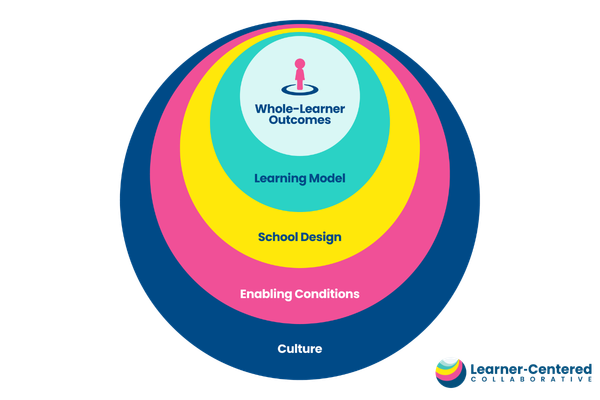
Shifting toward a learner-centered ecosystem means reorienting to change from the inside out. This learner-centered ecosystem begins with clarity of purpose. Communities come together to articulate the whole-learner outcomes that matter most. This shared North Star supports a learning model that is anchored in the science of belonging, learning, and motivation, and that describes the types of experiences students should have in order to develop those outcomes. Schools are redesigned to make those experiences possible, and enabling conditions—coherence, communication, aligned systems, talent development, and partnerships—are aligned so that the work is coherent, humanizing, and sustainable.
The culture is the heartbeat of the ecosystem. It requires a paradigm shift from the school-centered model to a deep belief in young people and in one another, paired with trust that fuels collaboration and continuous improvement.
Moving a deeply entrenched system requires more than vision. It requires a new way of operating. It requires a district-embedded R&D system.
Dive Deeper: Learn more about “A Learner-Centered Ecosystem”
Why We Need a Dual Operating System
We cannot—and should not—tear down our existing systems overnight. Children rely on them. Families rely on them. Educators rely on them.
That’s where Kotter’s dual operating system becomes a critical framework for learner-centered change in education. As Kotter suggests, innovation becomes possible when we intentionally design a new, networked operating system that is connected to our current one.
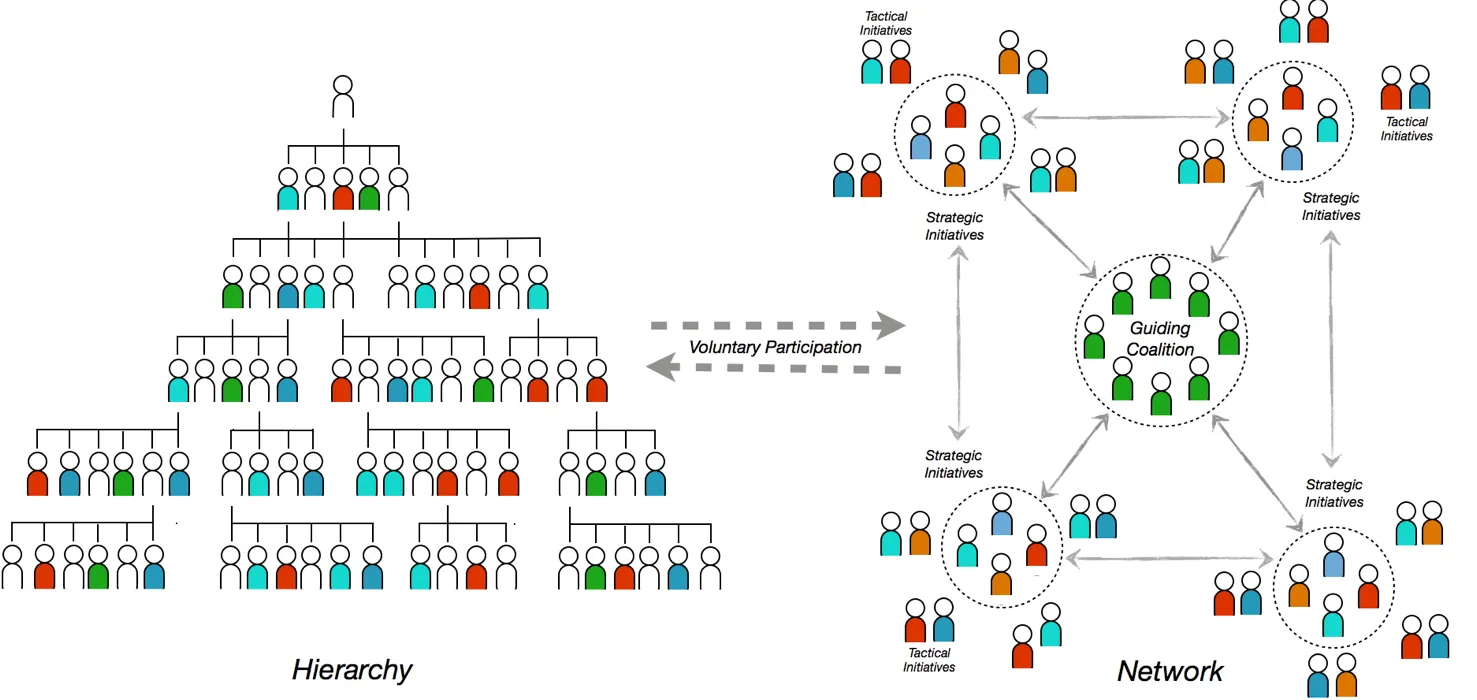
The new operating system provides the structure to experiment, prototype, and evaluate new models that reflect community aspirations. Rather than top-down reform or pockets of excellence that get little traction, this is a new path that enables R&D. A cross-functional design team that is intentionally created to build the future is fueled by a coherent vision, informed by research, and anchored in authentic problems and meaningful impact toward aligned outcomes.
This dual approach allows schools to:
- Protect what works.
- Question what doesn’t.
- Build and test what’s needed next.
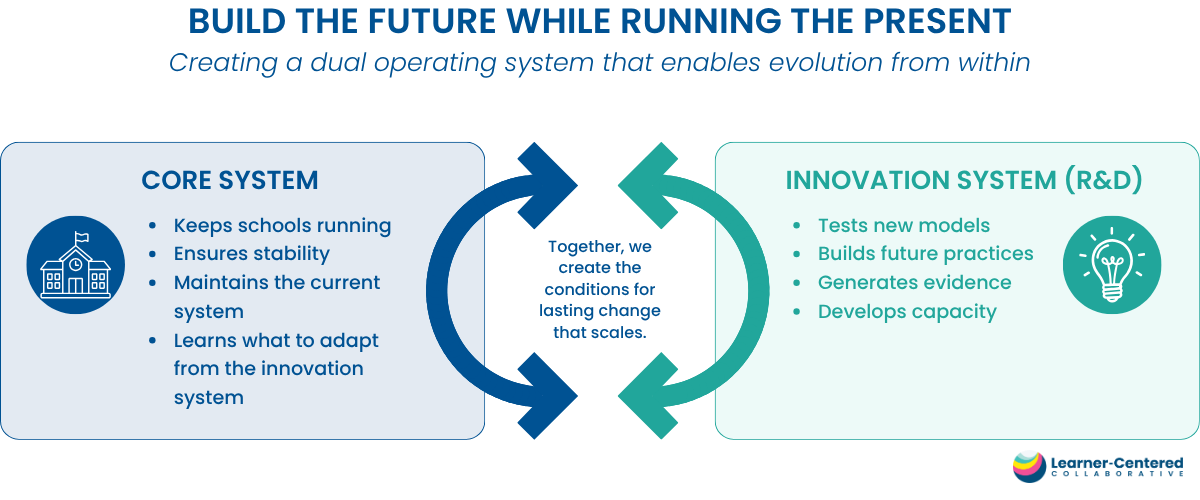
Importantly, the dual operating system is not an isolated initiative. It is a capability—a way of working that supports ongoing, adaptive improvement. It requires ambidextrous leadership: the ability to effectively lead and improve the systems that exist today while simultaneously creating the conditions to explore, test, and build what is needed for the future.
In this context, R&D begins with a clear vision that names the change we seek, identifies what we are willing to disrupt, and holds what we believe to be sacred. Leaders create the space and permission for innovation while maintaining the coherence, trust, and stability necessary for the broader system to maintain consistency.
This work requires co-design with community members, students, and educators—deeply understanding lived experiences, surfacing insights, prototyping new approaches, and learning fast. Success is determined not by how faithfully an initiative is implemented, but by whether what we are learning and building actually improves learning, belonging, and opportunity—and whether those lessons strengthen and evolve the broader system.
Build your design team today with our interactive Design Team Builder tool.
System-embedded R&D happens through iterative cycles of designing, testing, and reflecting. Cross-functional design teams engage in rapid Innovation Design Cycles, leveraging principles from design thinking, improvement science, and change management frameworks to understand the context and needs of the community, most importantly learners, co-design with them and test in real classrooms, ultimately reflecting and scaling what works back into the core system. Below is an overview of each phase of the Innovation Design Cycle followed by real examples of systems that have put this in place in their context.
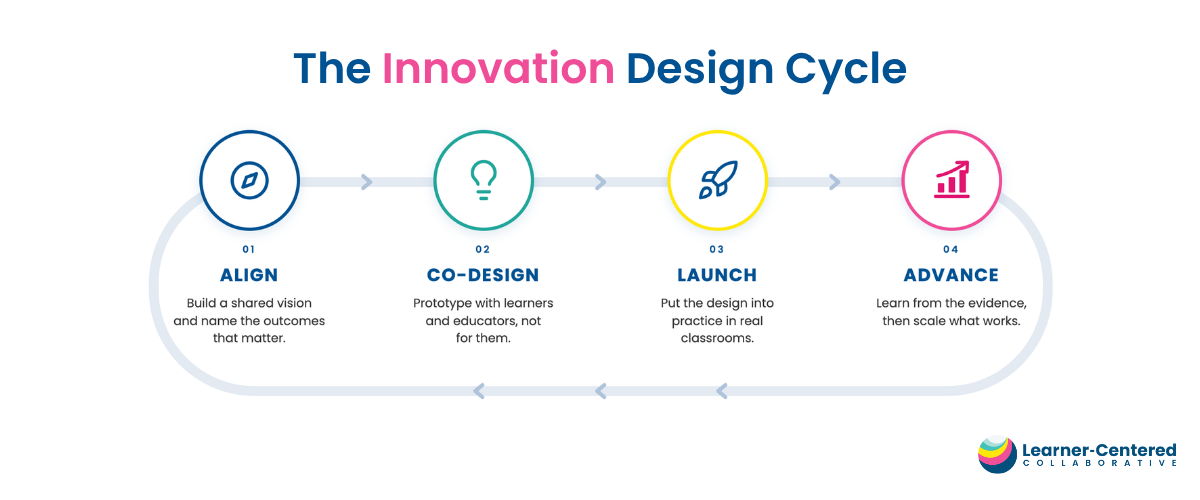
Phase 1: Align
Understand and Focus
This phase focuses on deeply understanding learners, educators, and the system as it currently exists. Rather than assuming teams know what problems need to be fixed, they intentionally listen to learn—elevating bright spots, examining data, surfacing lived experiences, and building shared understanding.
Using empathy interviews, student shadowing, listening circles, and data reviews, teams gather qualitative stories and quantitative signals to understand where learning is thriving and where barriers persist. The goal is not diagnosis for compliance, but collective sensemaking that builds trust, clarity, and momentum around the opportunities and barriers to their desired outcomes.
The resulting designs will look different across communities. A cross-functional design team might redesign an advisory experience, develop a new performance assessment, create a career-connected pathway, launch a microschool, or rethink an entire school model. The intent is not to prescribe a single solution, but to create intentional on-ramps for innovation that fit different contexts, needs, and levels of readiness.
Phase 2: Co-Design
Imagine and Build
With a shared understanding in place, a design team often comprised of administrators and practitioners moves into co-design. The goal is to turn shared understanding into possibilities for action. Educators, leaders, and learners work together as designers, bringing different expertise and perspectives to imagine solutions that reflect their needs, aspirations, and local context.
Bookmark this Design Team Builder Tool for your next design sprint.
Rather than designing for people and asking for feedback afterward, teams design with the people who will experience and implement the change. Together, they explore possibilities, identify promising ideas, define what success could look like, and build prototypes to be tested in authentic settings.
Co-design ensures that innovation is grounded in lived experience rather than imposed from above—and builds the ownership, relevance, and collective capacity necessary to bring new ideas to life.
Co-design is how systems move from vision to action in a learner-centered R&D model. Instead of designing change for educators, students, and families, districts design with them to identify the biggest opportunities for transformation and define what success should look like together. By engaging stakeholders in defining desired learner outcomes and success metrics, teams prototype their ideas to test in their community.
Phase 3: Launch
Test and Learn
Rather than rolling out large-scale initiatives, this phase emphasizes bounded experimentation. Design Teams co-create and test low-risk, high-learning prototypes in authentic settings—classrooms, grade bands, or schools.
Teams engage in short learning cycles to prototype, test, gather feedback, and refine. Evidence of impact includes learner outcomes, educator experience, and feasibility within real constraints. Stories of learning—both successes and challenges—are intentionally surfaced to normalize learning, reduce fear of failure, and strengthen collective capacity.
New ideas rarely produce immediate long-term outcomes. Real evolution of systems happens through cycles of implementation, learning, refinement, and growth over time. That’s why systems must first focus on whether new practices are being implemented meaningfully before expecting measurable shifts in traditional outcome metrics. Implementation comes first. Improvement and efficacy come next. Long-term outcomes emerge over time as systems learn what works, for whom, and under what conditions.
Dive deeper on Knowing What to Measure and When During Your Redesign Journey
To support this process, districts need multiple forms of evidence—not just end-of-year accountability measures. This includes activity data that shows who is participating and what is happening; experience data that captures feedback from learners, families, and educators; observation data that identifies emerging practices, patterns, and challenges; and outcome data that tracks how learner and system goals evolve over time. Together, these different types of evidence provide a fuller picture of progress, helping systems continuously improve rather than simply measure compliance.

Phase 4: Advance
Reflect and Grow
This phase is about reflection with purpose. Teams analyze both impact data and lived experience to determine what should be scaled, adapted, refined, or sunset. The goal is not simply to evaluate isolated initiatives, but to use what is learned to continuously strengthen and evolve the broader system. Insights from implementation help districts rethink policies, structures, schedules, professional learning, resource allocation, and leadership practices so that the desired learner-centered approaches become embedded into the daily work of schools. Sustainability comes from intentionally integrating effective practices into existing systems, supports, and strategic priorities—not treating innovation as separate from core operations.
Equally important, teams share stories of impact—amplifying learner voice, educator leadership, and visible wins across the system. Communication and connection become strategic levers for building trust, deepening collective ownership, and creating momentum for change. By combining evidence, reflection, and storytelling, districts create feedback loops that help the system learn, adapt, and grow over time. This ongoing cycle of learning and evolution ensures that innovation does not remain isolated in pockets, but instead informs how the entire system develops the conditions, mindsets, and practices needed to sustain meaningful transformation.
Real-World Examples of District-Embedded R&D
District-embedded R&D isn’t theoretical. Learner-Centered Collaborative has been partnering with school districts across the country to leverage this R&D cycle to evolve practices. If you would like to learn more about any of the stories below and how we support districts like yours embed R&D in their systems, reach out to our team.
Muhlenberg County Schools used an embedded R&D approach to reimagine accountability in alignment with its Profile of Success.
Rather than adopting a prepackaged assessment model, the district formed a cross-role Design Team to research, design, and prototype a Defense of Learning experience that would make learner progress visible against the Profile’s competencies.
This team treated accountability as a test-and-learn process—piloting the Defense, gathering evidence from students and educators, and refining the model based on real-world implementation. After a successful pilot year demonstrated both rigor and relevance, the Board approved district-wide implementation in grades 3, 5, 8, and 12.
This approach illustrates how locally led R&D enables districts to iteratively design accountability systems that are authentic, aligned to community-defined outcomes, and sustainable at scale.
Encinitas Union School District used a district-embedded R&D approach to redesign its report card, treating accountability as both a technical and adaptive learning challenge.
A 30+ member Report Card Design Team—composed of teachers, instructional coaches, and school and district leaders—began by studying survey data from families and educators to understand how the existing standards-based report card was experienced in practice. The team researched national models, surfaced essential design questions, and iteratively developed prototypes that balanced long-term vision with near-term feasibility.
Between sessions, leaders tested technical constraints with IT, while design team members gathered feedback from learners, families, and colleagues, using that evidence to refine the design.
This ongoing cycle of research, prototyping, feedback, and iteration resulted in a redesigned report card launching in Winter 2025, including learner reflection on Profile competencies—and established a sustainable R&D process for continuously improving how learning is defined, measured, and communicated.
Learn more about Encinitas’ Report Card Redesign Process
Escondido Union School District used a site-based, embedded R&D approach to support school redesign, beginning with a first cohort of schools testing new learner-centered structures in context.
North Broadway Elementary entered the redesign process with a clear problem of practice—declining enrollment—and used R&D cycles to define and prototype a distinct school identity centered on its outdoor learning environment, known as “The Ranch.” Through iterative design, the school created multi-grade advisory communities called “Round Ups,” where students meet monthly with the same advisor over multiple years, strengthening relationships and mentorship across age groups.
Monthly “Ranch Days” provide choice-based exploratory learning, resulting in 50 new classes in the first year and a marked increase in student engagement.
To sustain and scale the work, North Broadway also tested a distributed leadership model, organizing staff into six strategic teams with shared ownership of the redesign. Design teams have continued meeting in subsequent years, supported by district-wide communities of practice that surface learning, refine implementation, and inform the district’s next redesign cohorts (all schools in the district are engaging in the redesign process within five cohorts spread out over five years).
This case illustrates how embedded R&D enables schools to prototype, learn, and scale learner-centered innovations while building coherence and leadership capacity across a district.
Learn more about Escondido’s district-wide school redesign journey.
This is a Unique Moment to Act
Federal and state policy landscapes are beginning to shift. There is more openness to redesigning accountability, expanding measures of success, and creating room for learner-centered innovation.
But systems don’t transform because permission was granted. They evolve because communities decide the status quo is no longer acceptable and work to create something better.
Teachers, students, families, site leaders, and district teams know what they want to see. They know what isn’t working. They know what is possible when learning is personal, relational, authentic, and rooted in purpose.
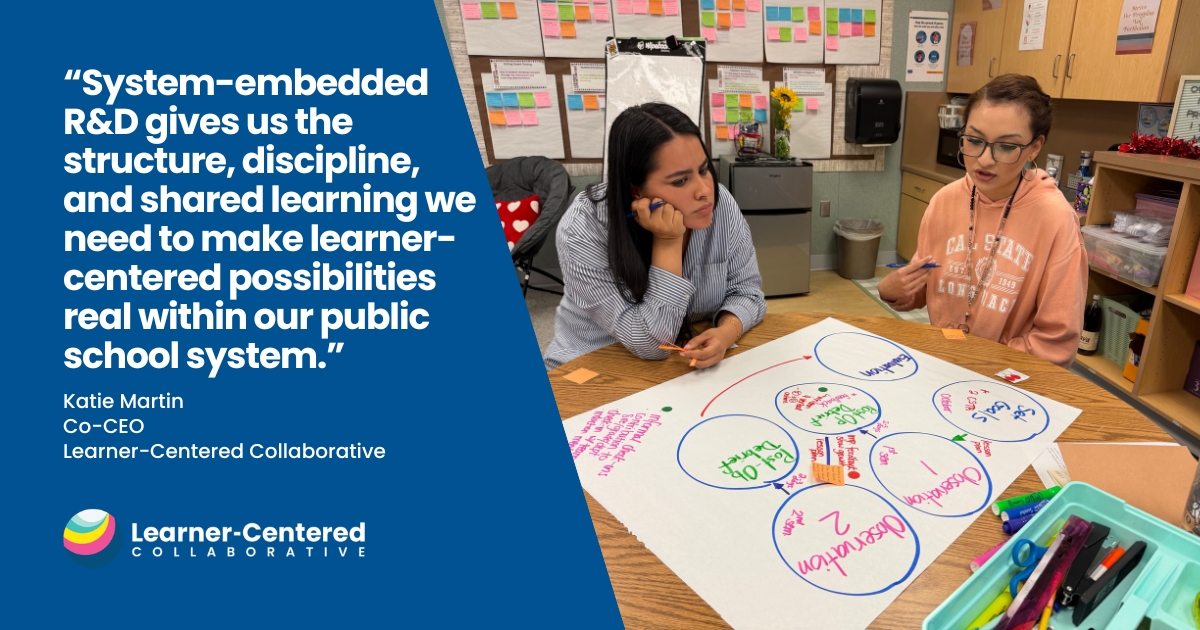
System-embedded R&D simply gives us the structure, discipline, and shared learning we need to make those possibilities real within our public school system, which has the infrastructure to sustain and scale the most impactful practices across the system when the right enabling conditions exist.
If we want education ecosystems where every learner knows who they are, thrives in community, and actively engages in the world as their best selves, we must build the capacity—not just the programs—to continually evolve.
We can’t wait for someone else to fix the system.
We are the ones who can do it, and we must do it together.