Episode 49: Rethinking Accountability—Policy, Practice, and the Future of Learning (with David Cook)
By loading this video, you agree to the privacy policy of Youtube.
Episode Summary:
David Cook, longtime Kentucky education leader and current CEO of Learning Ecosystems Design, shares insights from three decades of shaping assessment, accountability, and innovation policy. Reflection on his time at the Kentucky Department of Education, David describes how former Commissioner Jason Glass catalyzed a new era by rejecting top-down directives and instead launching a statewide listening tour and asking communities two specific questions: What was education like for you? and What do you want it to be for your children and grandchildren? The resulting “United We Learn” vision—centered on vibrant learning experiences, reimagining assessment and accountability, and community leadership. This work sparked a statewide shift toward competency frameworks, locally designed portraits of a learner, and new accountability models. Kentucky now stands on the cusp of adopting one of the most significant accountability evolutions in the country.
He and Katie explore what it really takes to align policy, culture, assessment, and teaching around deeper learning. Throughout the conversation, there is an emphasis on mindset shifts, the power of local ownership, and the need for transformation champions who help build sustainable state- and district-level coalitions. David shares why moving from measuring achievement to assessing evidence of learning changes everything for teachers and learners, and why asset-based approaches must be the focus in any impact-focused educational design.
Key topics from the episode include:
-
🧭 Building statewide transformation through community listening and shared vision
-
🏛️ Creating competency frameworks and portraits of a learner that inspire innovation
-
🔁 Shifting from achievement scores to evidence of learning through performance-based assessment
-
🤝 The role of coalitions, intermediaries, and transformation champions in sustaining system-level change
-
🌱 Moving from deficit models to asset-based approaches that honor learner humanness
-
🎓 What aligned, learner-centered systems make possible for teachers and students in everyday classrooms
Related Resources:
- Blog: Can Regional Innovation Hubs Create a More Promising Future for K-12 Education?
“Regional ecosystems offer the ideal scale for experimentation and evolution. They’re big enough to impact systems, small enough to build trust, and flexible enough to adapt to context. In short, regional hubs are where vision meets action.” - System-Wide Big Move: Defense of Learning
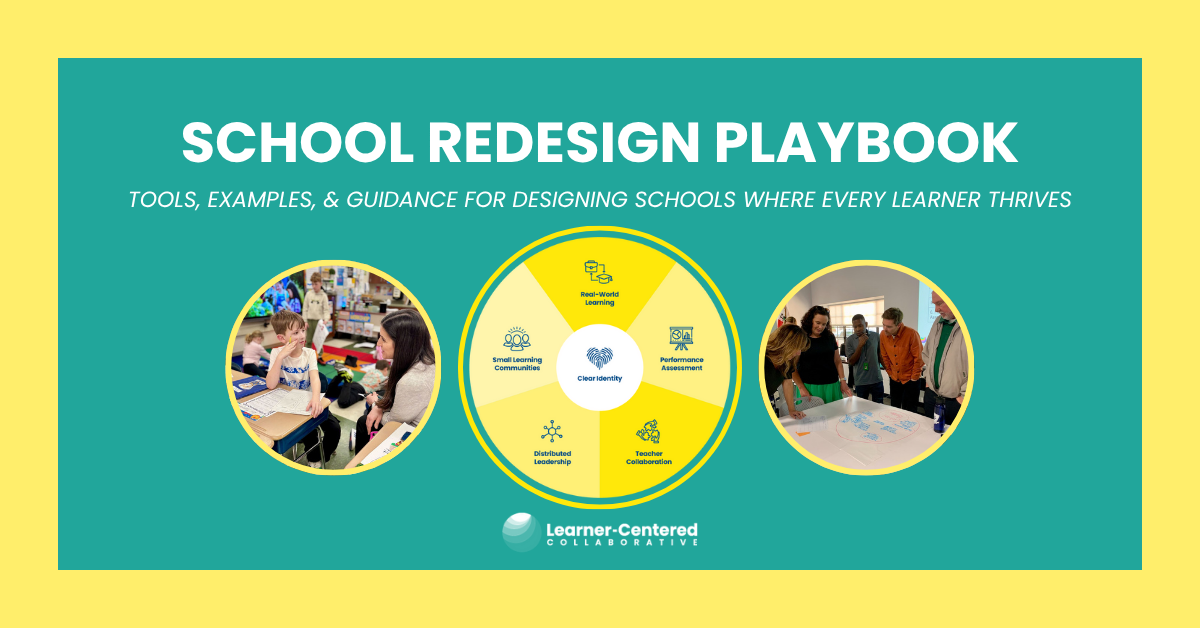
A school or district-wide defense of learning (sometimes called Presentation of Learning, Showcase of Learning, Demonstration of Learning or Celebration of Learning) is a way for students, at designated milestones or grade levels, to share a body of evidence of learning and reflect on how they grew towards their own and school/district goals, usually defined in a Portrait of a Learner. - Publication: School Redesign Playbook
This Playbook draws on Learner-Centered Collaborative’s work with schools and districts nationwide, highlighting communities that have redesigned school and learning in ways that reflect their unique contexts and aspirations.