School Redesign Playbook
For more than a century, schools have been shaped by an industrial-era model built for efficiency, standardization, and compliance. While that design achieved many of its original aims, it has not met the needs of all learners, and it no longer prepares young people for a rapidly changing world. In addition to content knowledge, learners need strong relationships, adaptability, social-emotional awareness, and the ability to think critically and solve complex problems.
Across the country, educators are already creating these kinds of learning experiences. Yet, the structures that shape daily school life often make this work difficult to sustain.
School redesign is therefore not about surface-level innovation. It’s about reimagining the purpose and design of school to align with the science of learning, human development, and the realities of today’s world.
This Playbook draws on Learner-Centered Collaborative’s work with schools and districts nationwide, highlighting communities that have redesigned school and learning in ways that reflect their unique contexts and aspirations.
Examples include:
- Conway Academy, in Escondido, CA: prioritizing whole-learner development through mastery of knowledge and skills, character, and high-quality work.
- Hālau Kū Māna Public Charter School, in Honolulu, HI: grounding learning in culture, community, and place.
- Alexandria City High School, in Alexandria, VA: providing student choice and connections between what students are learning and their futures.
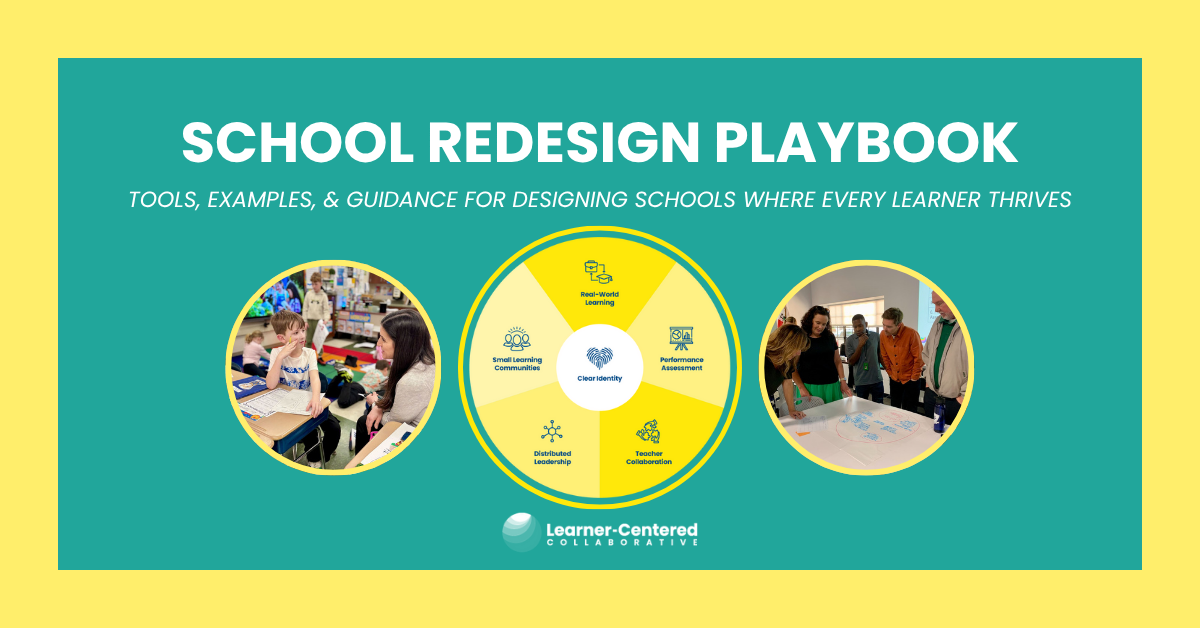
Through these examples, the Playbook explores five Learner-Centered School Design Structures that enable sustainable, learner-centered education:
- Small Learning Communities
- Performance Assessment
- Real-World Learning
- Distributed Leadership
- Teacher Collaboration
Ultimately, school redesign is about evolving toward what learners need now and in the future. This Playbook offers practical examples, frameworks, and tools to guide your journey, whether you’re beginning to explore redesign or already leading it, so every learner can know who they are, thrive in community, and engage meaningfully with the world.
Please complete the form below to access the site.