This Regional Network is Putting Learner-Centered Practice in Motion
This reflection emerges from a collaborative effort between Learner-Centered Collaborative and the University of California, San Diego Department of Education Studies. I am especially grateful to Dr. Dave Trautman, Dr. Mimi Lockton, and Dr. Alan J. Daly, whose incredible vision, design, and facilitation played a central role in bringing this work to life.
What happens when 10 educational organizations come together to engage in learning and create a network of support around shared problems of practice?
During the 2025-2026 school year, SoCal LiNK, a regional network in Southern California, gathered for four half days at University of California, San Diego (UCSD) to explore how we capture, communicate, and catalyze learning, while simultaneously accelerating learner-centered evolution through collaboration and shared practice.
SoCal LiNK is one of a growing number of interconnected regional networks organized by Learner-Centered Collaborative, intended to connect learner-centered practitioners so they can learn and grow together. “The social accountability of the network,” one district reported, “helped us tremendously in keeping this critical project moving forward.” Learner-centered work is complex, but no school or district has to do it alone.
Learn more about how Learner-Centered Collaborative works with schools and districts across the country.
This particular network was organized, designed, and facilitated in partnership with UCSD’s Department of Education Studies and serves as a strong example of a Research-Practice Partnership.
Each organization shared narratives, artifacts, and videos in a playbook to showcase what they do, and shared a Presentation of Learning that captured the importance of how they do the work.

Explore the SoCal LiNK Interactive Playbook
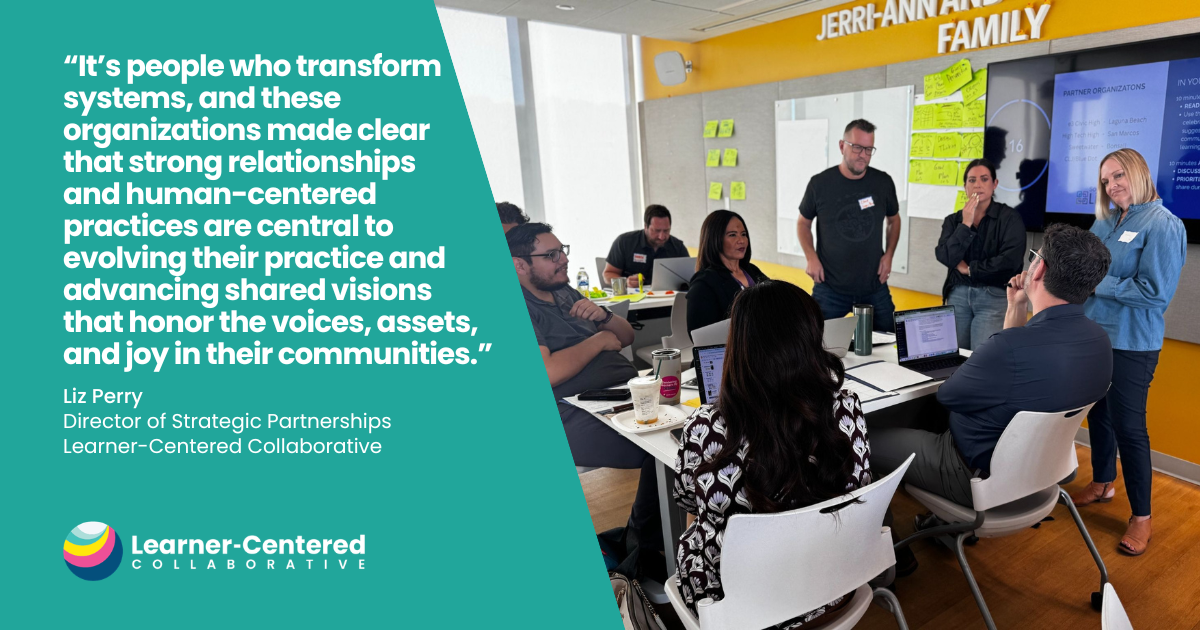
It’s people who transform systems, and these organizations made clear that strong relationships and human-centered practices are central to evolving their practice and advancing shared visions that honor the voices, assets, and joy in their communities.
Furthermore, by prioritizing time to come together as a network, these organizations signal the value they see in collaborating within and across organizations to improve practice. “Learning from other educators is always helpful and it makes us better educators too – to share and support one another,” reflected one SoCal LiNK participant. Strengthening relationships and collaboration creates a wider and stronger ecosystem across a region that allows participants to learn from one another and tackle a collective problem of practice.
Capturing, Communicating, and Catalyzing Learning Across the Region
During the 2025-2026 SoCal LiNK experience, participants reflected on, gathered evidence of, and shared strong and emerging practices of capturing, communicating, and catalyzing learning within their respective organizations. As schools and districts work towards new outcomes, many shared they were grappling with how to capture and measure growth towards these new goals. Through structured and meaningful collaboration, participants shared existing approaches and resources and sparked ideas for next steps.
Capturing Learning
Capturing learning refers to the process of documenting and making visible the growth, understanding, and development of learners and the ecosystems in which they learn. As educational organizations move from vision to implementation of their learner-centered visions, regularly gathering evidence of evolution helps organizations elevate bright spots and illuminate areas for growth.
Read More: Scorecards: How Might We Measure What Matters in Schools?
This year’s SoCal LiNK participants use various approaches to capture learning, from student portfolios and dashboards to goal-setting protocols and rubrics, to ensure that learning across these ecosystems doesn’t go unnoticed. Through elevating these practices, participants have been more intentional in their practices, looked deeper at them, and learned about new ones they can try out.
Communicating Learning
If we aim to evolve together and contribute to building thriving ecosystems, we must find ways to clearly communicate the journey of transformation across the system – with learners, their families, and the broader community. Strong communication helps clarify the vision, elevate bright spots, illuminate the role everyone plays, and sustain the momentum needed for transformation over time.
SoCal LiNK participants engage in various communication practices, such as student-led conferences, newsletters, showcases, and community events, to make learning visible and meaningful. Through the network, they have been able to reflect on their work and identify ways to communicate about it across their community. Strong communication about the learning taking place helps maintain a healthy ecosystem and is, in and of itself, one of the greatest catalysts for change.
Catalyzing Learning
Strong learning organizations use evidence of learning not just to assess the current state but to propel learning even further. Just as we use formative data in the classroom to monitor and adjust instruction, educational systems capture evidence in real time to inform next steps for evolution.
SoCal LiNK participants are not just documenting and sharing learning across their systems, they are sparking new possibilities for learners, educators, and communities. This year, participating organizations left inspired to transform mindsets and culture, strengthen student and family voices in decision-making, and improve alignment. These future actions support continued evolution towards learner-centered transformation.
Symmetry in Motion
During this year’s SoCal LiNK experience, the four sessions were intentionally designed to culminate with a showcase of learning via a public presentation and curated playbook. The design of each session and culminating experience provided space for collaboration and shared practice that mirrored the three Cs (capture, communicate, and catalyze) that framed our shared focus for the year.

SoCal LiNK participants collaborated across organizations to explore evidence-of-learning practices.
This mirroring, referred to as the practice of symmetry by Fine, Rincon-Gallardo, and Fullan in their recent book, Whole Learners, Whole Systems: Transforming School Districts for Adolescent Thriving, refers to the modeling of desired practices at all levels of an organization (or ecosystem). What we desire to see practiced at one level of the organization should be reflected and experienced at all levels.
As a regional network, modeling the practice of the three Cs helped us create a shared experience that strengthened coherence and reinforced the value of these practices at all levels – from the classroom to our shared collaborative space. We spent time during sessions capturing the group’s learning through shared artifacts, communicating with one another through structured collaboration opportunities, and pushing one another’s thinking around next steps through consultancy protocols. As we continue to structure and grow regional networks, how we structure these networks is as important as what we do.
Relationships Are Central: Growing Partnerships & Networks
“Keep this going. Publish it. Preach it. Expand it,” championed one SoCal Link participant.
As a regional network, SoCal LiNK is a strong example of a Research-Practice Partnership, long-term collaborations intentionally organized to connect diverse forms of expertise with the goal of producing actionable knowledge through research. SoCal Link is just one type of regional network that creates the space and time for regional partners to come together to reflect, collaborate, and co-create.
Participants in SoCal LiNK valued:
- “The space, resources, frameworks, and opportunities for reflection.”
- “Protected time, learning from other organizations.”
- “Connecting with and learning from other education organizations who are on similar journeys.
Other regional partnerships at LCC, such as our Microschool Network, North County Superintendent Network, and CCEE Secondary School Redesign Pilot, aim to connect practitioners together, informed by research, to grow an even wider and more robust ecosystem across our organizations.
When organizations are networked to learn with one another, not just alongside one another, learners across the region benefit, and we become part of a stronger, more connected ecosystem of mutual support.
Interested in joining one of Learner-Centered Collaborative’s regional networks? Connect with our team today to learn more.