Episode 37: Building Collective Efficacy and Insights on Transforming Education Systems with Dr. César Morales

By loading this video, you agree to the privacy policy of Youtube.

Episode Summary:

Dr. César Morales, Partner at Learner-Centered Collaborative, joins Katie Martin to share his journey from struggling high school student to transformative educational leader. With extensive experience as a teacher, coach, principal, and district leader, César highlights the pivotal moments and strategies that have shaped his leadership philosophy and his commitment to learner-centered systems.

César recounts his personal educational transformation, the influence of key mentors, and the lessons learned from leading the founding of Sage Creek High School in Carlsbad, California. He reflects on designing a school with a clear vision, creating a learner-centered culture, and empowering students to take ownership of their learning through initiatives like the Genius Project. Dr. Morales also discusses his dissertation research on collective efficacy, emphasizing its role in enabling school and district leaders to successfully navigate and implement learner-centered paradigms. He concludes with an inspiring vision for educational systems where learners of all ages can show up authentically and pursue their potential in environments designed to nurture growth and exploration.

Key topics covered include:

  • 👓 The importance of clear vision and mission statements in fostering innovation and alignment.
  • 🗺️ Co-creating educational frameworks with diverse stakeholders, including students, parents, and teachers.
  • 🧭 Developing systems that empower students to exercise agency and self-discovery in their educational journeys.
  • 🤝 Building collective efficacy among educators to drive transformational change at the district level.
  • 🚀 Strategies for leaders to enact transformational leadership through clarity, creativity, and collaboration.

Related Resources:

  • Blog: Understanding and Influencing Collective Efficacy: The Key to Driving Transformative Change in Education
    This blog emphasizes the critical role of collective efficacy—defined as the shared belief in a team’s ability to overcome challenges and achieve goals—in driving transformative change in education, outlining strategies for leaders to cultivate it through vicarious learning, verbal persuasion, emotional arousal, and mastery learning.
  • Course: Learner-Centered Leadership for Meaningful Change
    Define who you are as a learner-centered leader, explore ways to build relationships with your team by building relational trust, and leverage a human-centered design process beginning with empathy to create a proposal for change.
  • Tool: Enabling Conditions & Culture Self-Study
    Access this comprehensive resource designed to help educational systems assess and improve their foundational elements for success. This self-paced assessment covers six crucial areas: Coherence, Communication, Aligned Systems, Growth & Development, Partnerships, and Culture.

How About Another?

No results found.

It’s Your Journey

Explore More Topics

Blog
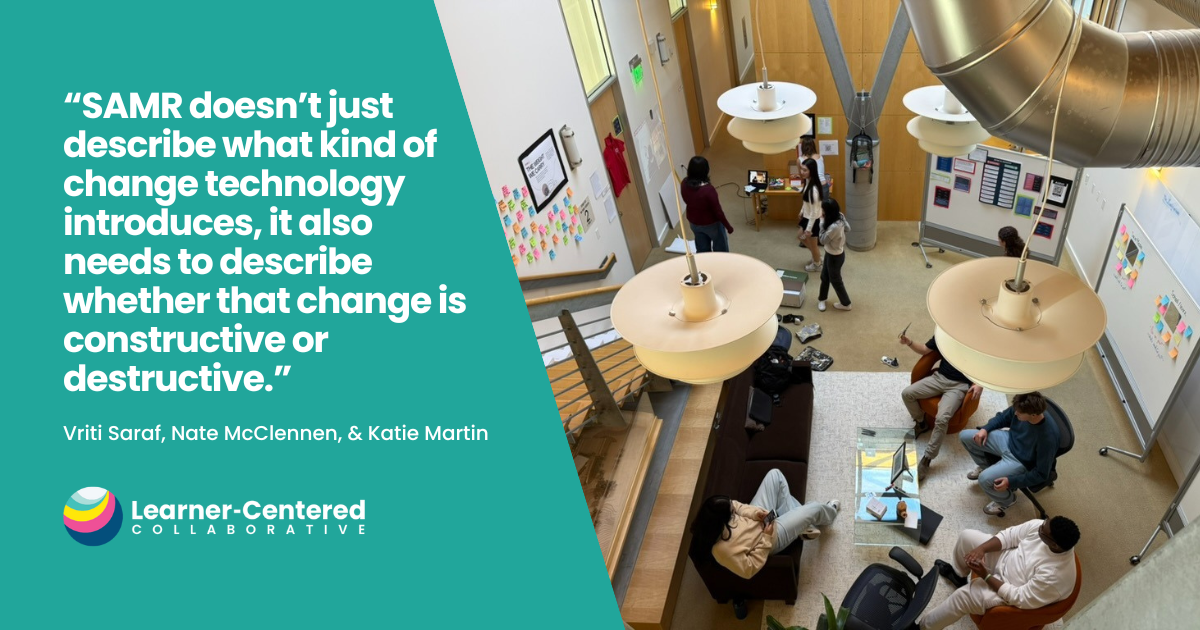
Rethinking SAMR in the Age of AI: Why the Model Needs a Second Axis
This article originally appeared on Getting Smart and has been republished with their permission. Written by Vriti Saraf, Nate McClennen, & Katie Martin Key Points The SAMR model needs a second axis (positive vs. negative impact) to better evaluate AI’s effect on teaching and learning. AI’s role in education is nuanced—its success depends on…
Blog
What an 8th-Grade Defense Taught Me About Competency-Based Learning
Written by Maysa Dadmun Have you ever watched a student light up when they get to learn about something they truly love? That spark is what shaped my entire 8th-grade defense project, and now, as a freshman in high school, it’s shaping the way I approach learning every day.  I attended Sussex School, a…
Blog
If No One Was Telling Us What To Do, What Would We Build?
For decades, K-12 educational leaders have worked within a system and structure of someone else’s design. We’ve generally been operating with an “outside-in” policy model where Federal rules, funding, accountability systems, and compliance requirements have shaped what we do and how we think about what is possible. State Departments and local education agencies have…