Learner-Centered Ecosystem Self-Reflection

Moving toward a learner-centered ecosystem starts by shifting away from a school-centered way of operating and toward one built around what learners need. For schools and districts that have made that choice, it can be hard to see how far you’ve come when you’re in the middle of the work. The Learner-Centered Ecosystem Self-Reflection gives you and your leadership team a structured space to pause, look honestly at your current practice, and notice what’s already taking root.
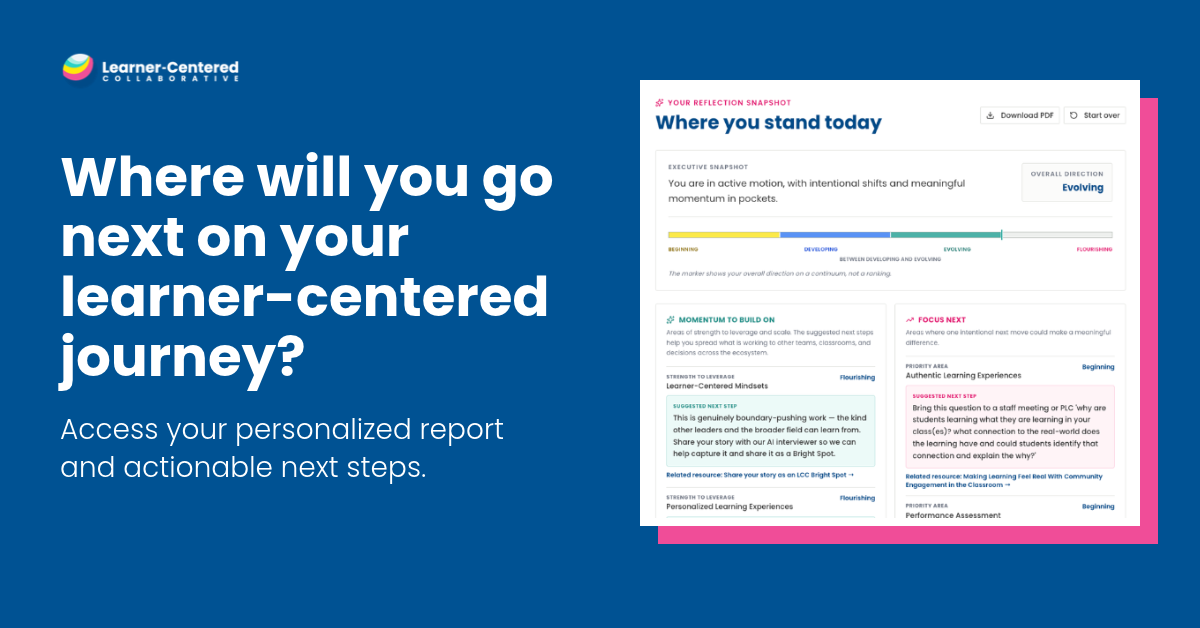
You’ll reflect on 18 indicators across four layers of your ecosystem, placing your school or district along a continuum from Beginning to Developing, Evolving, and Flourishing. This reflection aims to clarify where your momentum is building and where a focused next step could make the biggest difference for the learners you serve.

When you finish, you’ll receive a personalized report that highlights your system’s strengths, suggests focus areas, and connects you with next steps and resources from Learner-Centered Collaborative to help you continue evolving. Take the Ecosystem Self-Reflection to see where your system is today, and what might come next.

It’s Your Journey

Explore More Topics

Blog
Direct Instruction, the Science of Learning, and the Danger of a Single Story
Reflections on Season 2 of Sold a Story As I listened to the first episodes of the new Sold a Story series, I was struck by the story of Zig Engelmann’s earliest experiments teaching young children. Much of the podcast series’ framing and public reaction has focused on his approach to Direct Instruction and…
Blog
Moving From the Why to the How of Learner-Centered Change
  Over the last decade, a meaningful portion of the “school change” conversation has been dedicated to the potential value and creation of graduate portraits (at the district and state levels), and I have been encouraged by how much energy that work has generated. As Katie Martin has said previously, Learner-Centered Collaborative specifically uses…
Blog
Why Community Schools and Secondary Redesign Belong Together
California has made an unprecedented investment in community schools, which often include four evidence-informed programmatic features that are aligned and integrated into high-quality, rigorous teaching and learning practices and environments: Integrated support services; Family and community engagement; Collaborative leadership and practices for educators and administrators; and Extended learning time and opportunities. Since 2021, the…