Direct Instruction, the Science of Learning, and the Danger of a Single Story
Reflections on Season 2 of Sold a Story
As I listened to the first episodes of the new Sold a Story series, I was struck by the story of Zig Engelmann’s earliest experiments teaching young children.
Much of the podcast series’ framing and public reaction has focused on his approach to Direct Instruction and the impressive academic outcomes that followed. What I think gets lost is that Direct Instruction was only one piece of his learning design. In a two-hour learning experience, Engelmann committed one hour to Direct Instruction and one hour to play.
Yes, he provided carefully sequenced lessons and explicit teaching. But he also included time for learners to explore, interact, and build relationships. Combined, this full learning experience led to measurable academic gains.
The more I listened, the more I noticed other learner-centered elements showing up within the story’s narrative that were largely left unspoken. If these elements go unnoticed, we run the familiar risk of reducing a complex example of effective teaching and learning to a debate about a single instructional approach.
Here are six lessons I hope we take from Zig Engelmann’s work.
1. High Expectations and Personalized Support Go Hand in Hand
One of the most compelling aspects of Engelmann’s work was his belief that young children, including those often underestimated, are capable of significant learning and growth.
He understood that learning is developmental and contextual. He gave praise, encouragement, and motivation appropriate for preschoolers. There were handshakes, rituals, and relationships that created connection and community. When children struggled, he didn’t simply assume they lacked ability. He examined what needed to change in the instruction.
Underlying it all was a powerful combination of care, belief, and high expectations.
Every learner deserves access to challenging, meaningful learning experiences and the support to succeed.
The question isn’t whether we should have high expectations. It’s whether we’ve designed learning environments that provide every learner with the opportunity and personalized support to meet them.
2. Direct Instruction and Inquiry Are Not in Competition
One of my biggest concerns about the broader conversation is the tendency to create a false choice between explicit instruction and inquiry-based learning that is hands-on, contextual, and motivating.
Learners need both.
There are times when modeling, scaffolding, guided practice, and immediate feedback are essential for developing foundational knowledge and skills.
There are also times when learners need opportunities to ask questions, investigate ideas, solve problems, collaborate, and apply what they know in authentic contexts.
A child learning to decode words needs systematic instruction and practice. That same child also needs rich stories, meaningful conversations, and experiences that foster a love of reading.
A high school student studying environmental science needs foundational scientific knowledge. They also benefit from investigating local environmental challenges, analyzing evidence, and developing solutions.
Foundational knowledge enables deeper learning. Meaningful application gives that knowledge purpose.
We should be designing learning experiences that integrate both rather than arguing that one should replace the other.
3. Learning Is Developmental, Relational, and Contextual
Engelmann’s early experiments focused on young children. That context matters.
Preschoolers benefit from routines, repetition, play, positive reinforcement, modeling, and immediate feedback. These experiences support their development of language, foundational concepts, relationships, and understanding of the world.
Those needs are not identical to those of adolescents developing identity, independence, and the ability to navigate increasingly complex decisions.
Older learners still need explicit instruction. They also need increasing opportunities to exercise agency, pursue interests, make decisions, and apply their learning.
Across developmental stages, relationships, belonging, and motivation remain essential.
The handshakes, rituals, encouragement, and personal connections in Engelmann’s early work weren’t distractions from academic learning. They helped create the conditions for it.
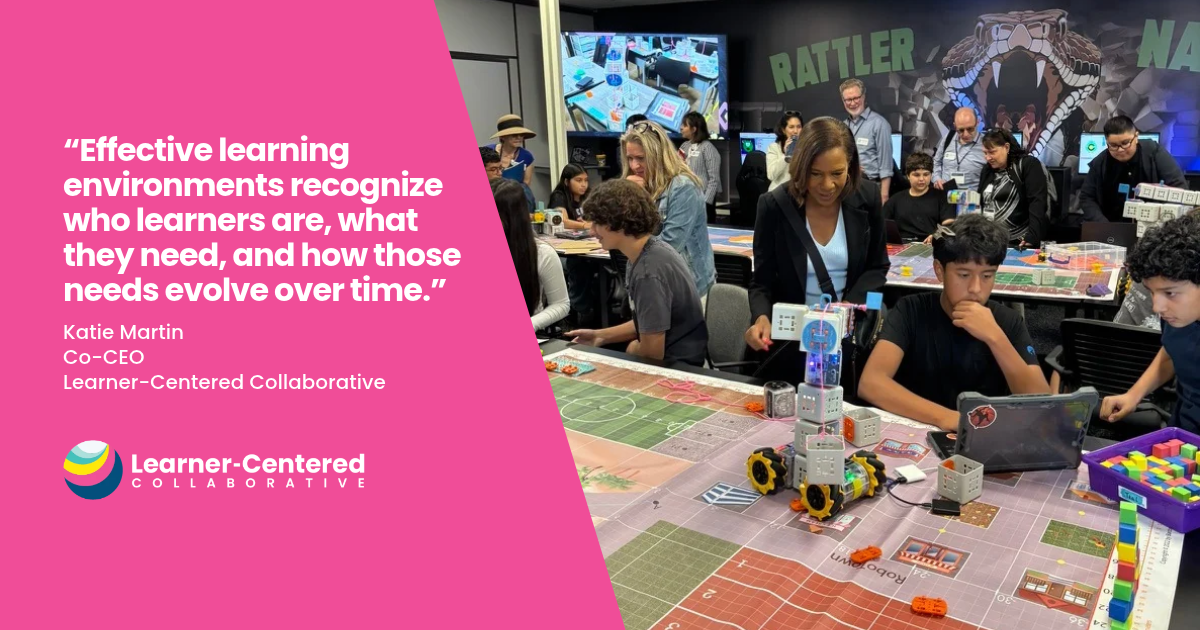
Effective learning environments recognize who learners are, what they need, and how those needs evolve over time.
4. Improving Learning Requires Investing in Educators
Perhaps the most important systems-level lesson is the attention Engelmann paid to teacher development.
Teachers had clear learning goals. They received feedback. They examined evidence of student progress and were expected to adjust their practice when students weren’t learning.
This is a powerful reminder that improving outcomes requires more than adopting a curriculum or instructional model.
It requires investing in educators.
Teachers need clear expectations and opportunities to develop expertise, collaborate, examine student work, receive feedback, and continuously improve their practice.
And just as learners need scaffolding, encouragement, and guidance, educators do too.
We cannot expect teachers to personalize learning and respond to evidence if their professional environments are built around compliance, isolation, and evaluation rather than systems that model and support growth and development.
If we want responsive learning environments for students, we need responsive learning environments for adults.
This requires school structures that provide time for collaboration, meaningful professional learning, coaching, and continuous improvement.
Read More: From Training to Professional Learning: Building a Learner-Centered Culture for Educators
5. Scale the Principles, Not Just the Program
One of the most important lessons from Engelmann’s work is what happens when promising approaches move from small, highly committed teams into larger systems.
Small programs can achieve extraordinary outcomes when educators share a clear vision, believe deeply in their learners, and continuously examine evidence to improve their practice. They develop strong relationships, respond to their communities, and refine their approaches based on what works.
But when we try to scale these models, we often focus on replicating the curriculum or instructional practices devoid of the conditions that made them successful.
The results of Project Follow Through remind us that implementation matters. Outcomes varied across sites, raising important questions about the roles of context, educators, leadership, and how instructional approaches were put into practice.
This is a challenge we see repeatedly in education. We identify something that works, package it into a program, and expect fidelity to produce the same outcomes everywhere.
But replicating a program is not the same as replicating the conditions that made it effective.
Curriculum matters. Evidence-based practices matter. Essential instructional principles matter. But so do educator expertise, shared purpose, relationships, leadership, and the ability to continuously improve.
When we reduce an effective learning model to a prescribed curriculum, we risk standardizing the most visible parts while losing the less visible conditions that made it successful.
The goal of scaling should not be to make every school look the same. It should be to create the conditions that allow effective learning to flourish in different communities.
That means being clear about the principles and outcomes that matter while empowering educators and communities to bring them to life in ways that respond to their learners.
6. We Need to Design Schools Around the Outcomes That Matter
The research on Direct Instruction and Project Follow Through offers important evidence about academic learning, particularly foundational skills. We should take those findings seriously while being thoughtful about their context and what they can tell us about the full K–12 experience.
We should care about developing literacy and numeracy skills and design systems and structures to ensure all learners are building the foundation in their early years of school.
But if our goals also include developing critical thinking, creativity, collaboration, agency, and the ability to navigate an increasingly complex world, we also need to intentionally design for and assess those outcomes.
This is why Portraits of a Learner are so important.
They challenge us to get clear about what our communities value most and then align learning experiences, instructional approaches, assessments, and school structures to those outcomes.
What we measure and prioritize shapes what we create opportunities for learners to develop.
We want students to learn to read so they can better understand the world.
We want students to develop mathematical fluency so they can solve meaningful problems.
We want students to master essential knowledge so they can apply it and contribute to the world.
These goals are complementary, not competing, but we can’t expect them to happen without redesigning the structures and systems in our schools to do them well.
Read More: Knowing What to Measure and When During Your Redesign Journey
Moving Beyond a Single Story
What concerns me most is the temptation to find one instructional approach that promises to solve all the challenges of education.
Learning is too complex, and learners are too diverse, for any single method to tell the whole story.
The science of learning and development has made clear that learners benefit from explicit instruction, scaffolding, feedback, practice, and high expectations. It has also cemented the fact that relationships, motivation, play, inquiry, agency, and authentic opportunities to apply are essential for deep learning.
The question isn’t which of these we should choose. It’s whether our schools are designed to make all of them possible.
Effective school redesign starts with getting clear about the outcomes that matter most to our communities and then designing the instructional approaches, structures, and conditions to support those outcomes.
That means creating time for collaboration, investing in educator expertise, using evidence to improve, and ensuring learners have opportunities to build foundational knowledge and apply it meaningfully.
We don’t need to choose between Direct Instruction and inquiry-based learning.
We need to design schools that honor both—and create the conditions for educators to meet learners’ needs with high expectations, evidence, care, and the support to continuously improve.