Meaningful Learning Is Not a Race: Lessons From the Slow Food Movement
When fast food first arrived in Italy promising a burger in two minutes, a countermovement for “slow food” quickly grew. The movement’s founder, Carlo Petrini, believed food should be “good, clean and fair.” He believed good food takes the time it takes, and that making a meal faster doesn’t automatically make it better. The value, instead, is in the growing, the preparing, and the sitting down together. Most of us understand this intuitively about food. Petrini’s vision for food is an invitation to consider what we prioritize about learning. Let’s set the scene.
A vendor walks into a leadership meeting with a compelling pitch. Their platform can help students master a semester of algebra in half the time. Heads nod around the table because faster feels like progress (it always has). But before anyone signs that contract, there’s a more important question worth sitting with. Faster toward what?
Read More: What is the Purpose of School? A Call for Whole-Learner Outcomes.
The promise of many programs and education technology has frequently focused on faster learning. Personalize the experience, speed it up, and put the technology at the center of it. The pitch works because it’s built on a compelling premise. What used to take a student ten hours to learn can, with the right tool, take two. Compress the time, the logic goes, and you free up the rest of the day for something better.
The kitchen can be fast. The meal shouldn’t be.
Here is what I think the Slow Food Movement, and restaurants that follow its principles, figured out. They never rejected efficiency. Their kitchens still run on prep schedules, sourcing logistics, and timed service, because a restaurant that can’t get food to the table within a “reasonable” time will quickly go out of business. What they refused to compress was the part that couldn’t be compressed without losing the thing itself, the actual eating, the conversation, the time at the table.
Schools have exactly that same split, and I think we’re often confusing which side of it we’re on. Walk into most secondary schools and count the minutes lost to passing periods, five to pack up, five to transition, five to settle in, six times a day. That’s the kitchen. That’s logistics, and logistics can and should be engineered for efficiency. It has nothing to do with how a learner actually does the work of understanding something new, which is the meal, and the meal is exactly what most pitches about compressed learning time are asking us to rush.
Here is where we keep tripping ourselves up. We treat “faster” as “better” in all aspects of education. When we chase speed for its own sake without asking which side of the kitchen we’re standing on, we are not redesigning school. We are running the same conveyor belt faster and calling it innovation.
Why the meal can’t be rushed
Cognitive science has understood this for decades, even if the language it uses is less appetizing than a restaurant metaphor. Schema theory describes three modes of learning:
- Accretion, adding new facts to what you already know
- Tuning, refining and adjusting the frame you use to make sense of something
- Restructuring, when the frame itself breaks open, and you see the world differently
You cannot skip from accretion straight to restructuring on command, and you cannot schedule the moment your thinking reorganizes itself.
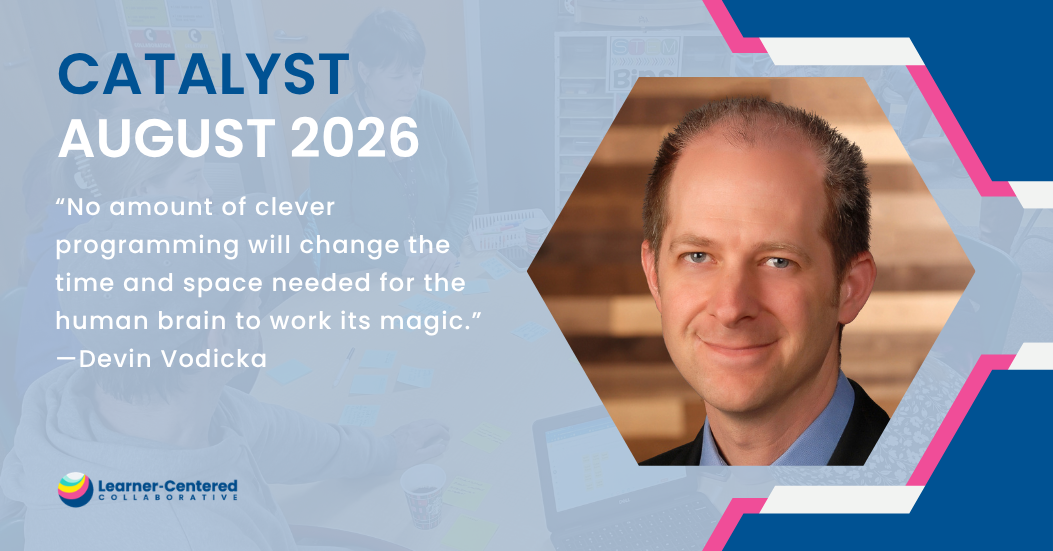
It tends to happen only after a learner has actually wrestled with a problem for a while, gotten it wrong a few times, and come back to it from a different angle than the one they started with. That is not inefficiency. That is the meal. No amount of clever programming will change the time and space needed for the human brain to work its magic.
School redesign as a countermovement
This is not just a philosophical stance. You can see it play out in the choices real districts make, and Escondido Union School District ran a version of the exact same countermovement the slow food restaurants did, refusing the drive-through model when everyone around them was racing toward it.
Escondido is in the middle of a multi-year effort to redesign what school looks like across all 23 of its campuses, and one of the most instructive parts of their work is what they refused to do. With 1,200 staff and 14,000 students, leaders could have mandated a single, compressed rollout, one Framework, one timeline, everyone moving fast together. Instead, they built a phased, cohort-based approach that gave every school room to develop its own identity and its own pace within a shared set of learner-centered structures.
Read More: What School Redesign Makes Possible When a District Says No to the Status Quo
Cherry Moore, the district’s Director of Teaching and Learning, put it plainly when advising future cohorts to start with goals small enough that everybody is willing to take a step. “If you make goals that are too big, or if you force everybody to go too fast, I think you’ll get your early adopters and innovative teachers way out in front and everybody else too far behind.” That is a leader choosing the slow food model over the drive-through, on purpose, because she understands that the kind of change that actually sticks, real restructuring and not just accretion, cannot be rushed into existence.
You can see the same pattern in Escondido’s classrooms. A fourth-grade teacher at Felicita Elementary described how redesign let her move past what she called “cookie-cutter stuff” toward work that let her students see themselves as leaders and public speakers who “really can make a difference.” A teacher at North Broadway Elementary was skeptical an outdoor classroom would work at all, until she tried it and came back so excited she couldn’t stop talking about it. That is tuning becoming restructuring, in real time, because someone protected the space for it to happen instead of rushing past it.
Asking a deeper question about education
The kitchen side of school, the logistics, the scheduling, the operational waste, is absolutely worth fixing, and I hope we keep fixing it. But before we ask how to compress the time it takes to learn something, we owe our students a deeper reflection. What is the purpose of education? Is it a race or are we trying to produce well-developed learners capable of navigating a complex world?
If it’s the latter, speed is never the goal. Depth is. And depth, like a good meal, like a redesigned school, like a mind coming to see itself differently, takes the time it takes.
We don’t get to skip the steps. We only get to decide whether we create the conditions for them to happen.
If your district is ready to protect those conditions instead of racing past them, School Redesign is exactly the work we’d love to help you start. Reach out here, and let’s build something worth taking the time to get right.