What School Redesign Makes Possible When a District Says No to the Status Quo
Inside Escondido Union School District’s multi-year effort to redesign school by turning a community-built vision into learner-centered experiences across every campus.
Story at a Glance
A quick look at the partnership, strategy, scale, and early signals behind
Escondido Union School District’s School Redesign journey.
| Partner Escondido Union School District | Focus Districtwide School Redesign | Scale 23 schools · 1,200+ staff · 14,000+ learners |
| Core Strategy A phased, cohort-based redesign process anchored in a community-built Framework for the Future. | Early Signals Stable outcomes overall, with promising middle school momentum in achievement and culture/climate. | Why It Matters Escondido’s redesign work is helping inform broader school transformation efforts across California. |
Introduction
On October 12, 2020, Escondido Union School District (EUSD), a K-8 public school district, resumed in-person learning after COVID-19 restrictions began lifting in the San Diego area. A moment educators across the country can distinctly recall, and, for many, a time where “returning to normal” was the singular goal. For Escondido’s district leaders, the goal was the complete opposite.
During the COVID shutdown, Superintendent Dr. Luis Ibarra created the EUSD Design Team. Consisting of labor partners, classified staff, teaching staff, parents, and community members, they had two core goals: 1) to ensure the community’s health and safety needs were being supported and 2) to lay the foundation for an opportunity to reimagine what learning could be throughout the district.
The community was motivated and energized to do more than tread water. They saw an opportunity to do better. As Dr. Ibarra noted, “When we were done with COVID, I remember asking the group whether we were going back to the same status quo and whether what we were doing was working for us. And, of course, the answer was no.”
“No” opened a new world of possibilities for the district, and two years later, those possibilities began coming to life.
Framework as Foundation
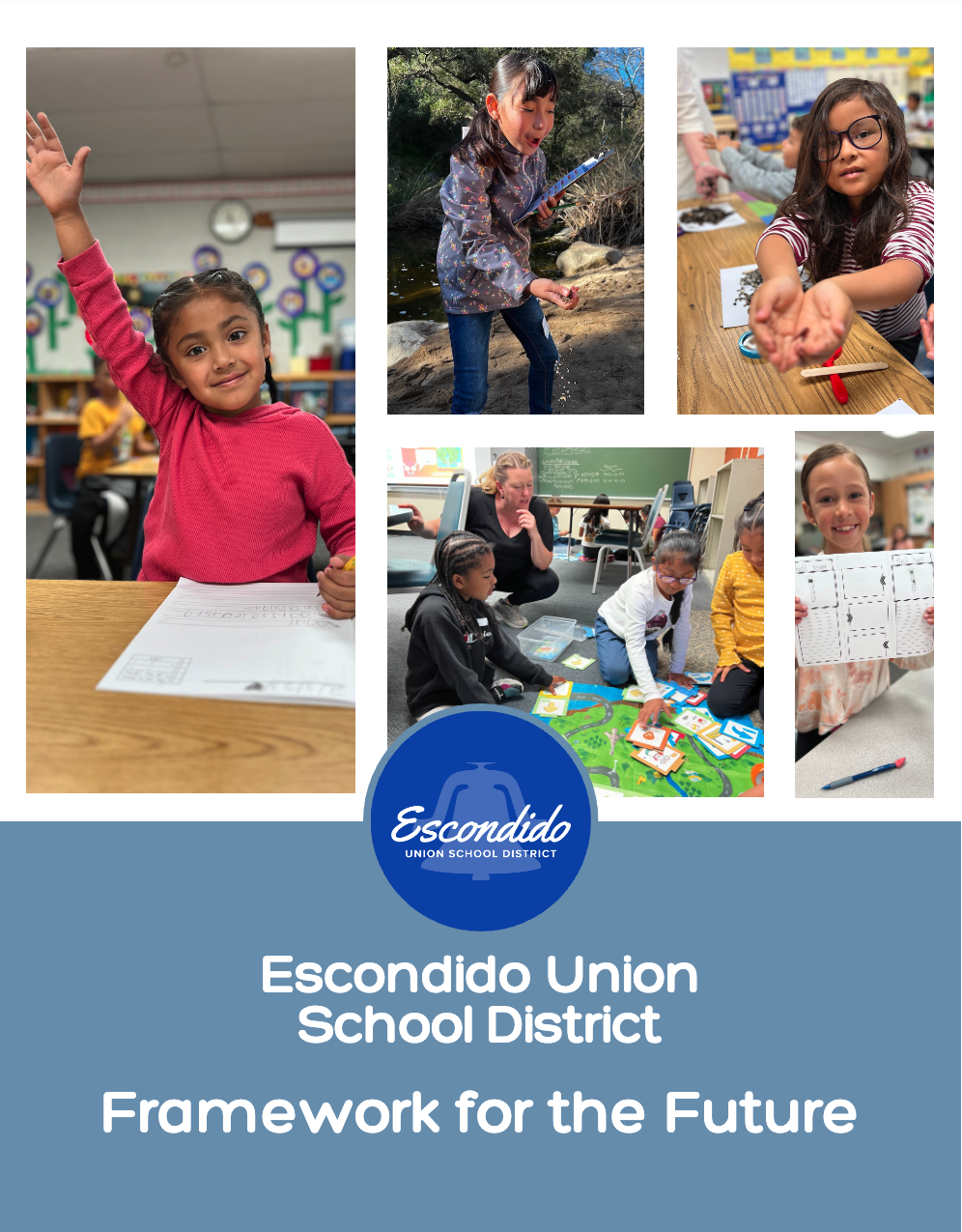
Partnering with Learner-Centered Collaborative in 2022, the EUSD Guiding Coalition, an expanded group of its original Design Team, began co-developing the district’s Framework for the Future. The Framework includes a Learner Profile (or Portrait of a Learner), a new Learning Model, and five Big Moves the district wants to make by the end f the 2028-29 academic year.
This collaborative design process strengthened leaders’ sense of collective efficacy—the shared belief that they could successfully transform the system. They met regularly to provide change-management support and create space for connection and coherence across schools and the broader community.
Research examining the Framework’s creation found that the holistic, co-constructive process helped leaders move from simply knowing the district’s vision to understanding how to operationalize it. While the phrase “Escondido Union School District will actualize the unlimited potential of every learner” was already widely known across the system, leaders reported that the Framework provided greater clarity about how that aspiration could be realized in practice (Morales, 2024).
“The Escondido Union School District will actualize the unlimited potential of every learner. We will be empowered, encouraged, engaged, and committed. In EUSD, equity is achieved when all students receive the resources and support they need to be successful.Escondido Union School District’s Vision Statement
The Framework for the Future declared a renewed purpose for the district, which was already being felt throughout the Framework’s development given Learner-Centered Collaborative’s emphasis on centering student voice.
Beginning with nine student forums, the EUSD Design Team gathered data and insights about the learning experiences students valued and the skills they needed for success in college, career, and life. This information was central to the district’s Learner Profile and Learning Model.
Together, these elements created coherence across the system—connecting the district’s purpose, the learning experiences students should have, and the strategic actions needed to bring that vision to life. This coherence strengthened leaders’ sense of collective purpose and capability, reinforcing their belief that meaningful system transformation was possible (Morales, 2024).
To hone in on the district’s Big Moves, a “Scout Team” consisting of EUSD Design Team participants and School Board members went on six school Discovery Visits to more deeply understand the strengths and opportunities for learner-centered evolution in the district.
Excited by “what could be,” the first Big Move everyone rallied around was School Redesign. Cherry Moore, former Principal at North Broadway Elementary School and current Director of Teaching and Learning, recalled, “we knew that what we were doing wasn’t working for all kids, and we couldn’t just keep doing the same thing and expect different results.” Specifically, each school would be charged with designing and implementing a learner-centered Redesign Action Plan that promoted the whole-learner outcomes and learning experiences detailed in the district’s Framework.
With 23 schools, over 1,200 staff, and over 14,000 learners, district leaders knew they needed an intentional approach to realize their School Redesign goals. If they pushed for too much too fast, they’d risk overwhelming all stakeholders. If they went too small and too slow, they’d risk losing the spark and energy the Framework was generating throughout the district. A clear strategy was essential.
Download Learner-Centered Collaborative’s School Redesign Playbook
Designing for Change at Scale
Continuing their partnership with Learner-Centered Collaborative, EUSD created a phased, cohort-based approach that balanced the readiness of each school site with the reality that every school would begin its redesign journey in the next five years. There was flexibility on “when,” not “if,” which reinforced the district’s commitment to the co-created strategic direction outlined in the Framework for the Future.
When school sites were more hesitant to get started, a gentle nudge from a trusted leader helped bridge any perceived readiness gaps. As Jason Wrzeski, Principal at Bear Valley Middle School and Cohort 2 participant, recalled, “At first, I was kind of hesitant. I didn’t sign up right away, but then I was asked to. I’m so thankful that we did because it’s been a great, great experience…This whole process has exceeded my expectations.”
The hesitations are to be expected. Learner-centered leaders, whether at the district or school level, know the importance of relational trust in moving any work forward. Although the Framework was created with a diverse stakeholder group, it still only included a small fraction of the district community. Each school needed time to have group and one-on-one conversations with its teams to build understanding of the district’s direction and the benefits they might expect to see as a learning community.
At the same time, Superintendent Luis Ibarra consistently elevated “bright spots” in his communications to staff and the community. By highlighting emerging examples of practice, he helped build shared ownership, reinforce progress, and generate momentum throughout the journey.
Redesign at EUSD, then, was not launched with a mandate or a manual. School-by-school, cohort-by-cohort, it unfolded through conversations, trust-building, and a shared willingness to try something different. Once a school opted into a cohort, the change process began unfolding in earnest.
Inside the Redesign Experience
Learner-Centered Collaborative emphasizes that the first step of every School Redesign journey is establishing a unique identity. In EUSD, it was imperative that no school felt like it was simply imitating what another was already doing. This was especially important to Laura Ruggles, Principal at Rose Elementary (Cohort 2).
Rose is one street away from Conway Academy of Expeditionary Learning, an early example of what School Redesign can make possible within the district. When Ruggles introduced the School Redesign Big Move to her staff, she recalled, “Teachers were wondering, is that what the hope is? That we’re going to become like Conway?” This question wasn’t a negative judgment toward Conway. It was a fear that their autonomy as professionals and unique identity as a school community could be taken away.
Regardless of the school’s forthcoming changes, everyone wanted to ensure Rose Elementary felt like Rose Elementary, and Ruggles was able to assure her staff: “We’re going to be our own school. We have autonomy to make decisions for our school.”
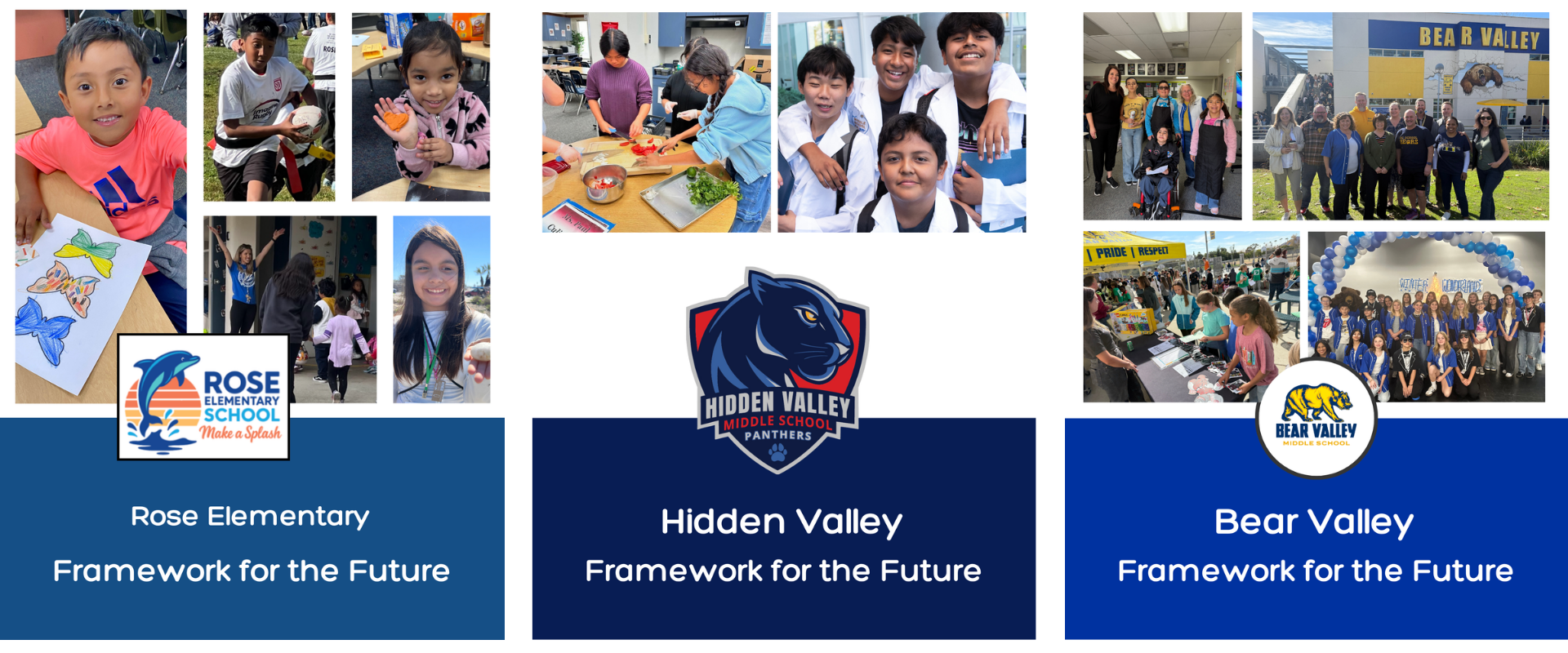
Ruggles could confidently calm her staff’s nerves because the first year of School Redesign in EUSD looks and feels similar to the district’s Framework process. Each school develops a vision, mission, and slogan along with a “Day in the Life” narrative and school-specific Big Moves. All of which are informed by the district’s Learner Profile and Learning Model (see Framework examples below). This process perfectly balances the ability to create a unique school identity and maintain coherence and alignment as a district.
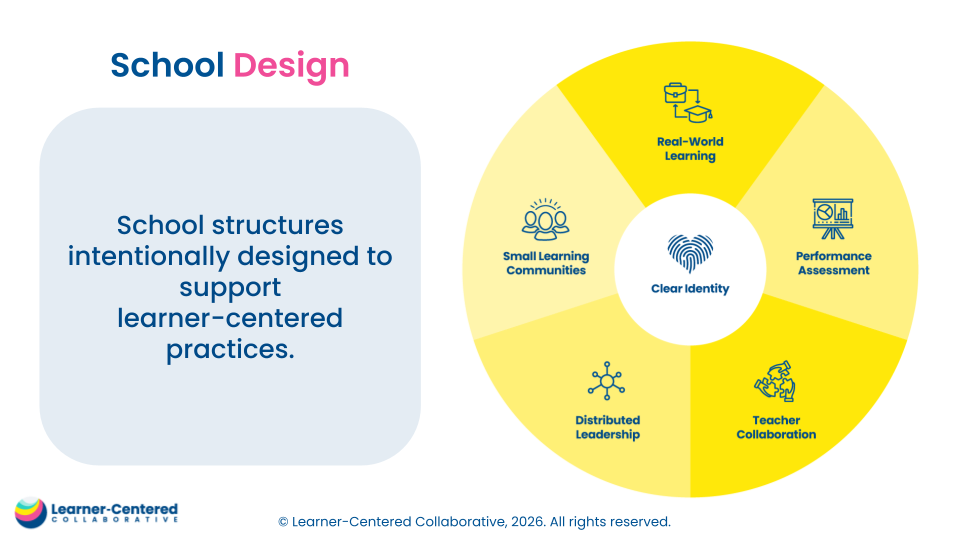
The School Redesign process starts with establishing a school’s unique identity, but that’s just the beginning. Across EUSD, school teams anchor their work in Learner-Centered Collaborative’s five other learner-centered design structures: small learning communities, distributed leadership, teacher collaboration, performance assessment, and real-world learning. These structures provide the architectural frame. Within that frame, each school defines how those elements come to life in ways that reflect their community, learners, and staff strengths.
For many educators, redesign addressed a tension that had been quietly building for years. As Katie Lyon, fourth-grade teacher at Felicita Elementary (Cohort 3) reflected, “we had kids who weren’t excited to be at school…I felt like there was a lot of cookie-cutter stuff happening.” Students might be able to perform the required skills, but the connection to purpose and real-world impact was often unclear. School Redesign created space to reexamine that disconnect.
Lyon described how she “was immediately excited about the idea of redesign. She reflected, “we all work so hard that I was excited to try something new that might allow more progress and get our students ready to participate in a world that’s forever changing.” Once her school began building its Redesign Framework, the size of what they were doing became real, but it didn’t discourage her. “There was a part where I was like, oh boy, this is a big undertaking, but the process of it was so well laid out and there were people at every step of the way that said ‘this is going to feel messy’ but would reassure us we would get through this, and on the other end, it’s going to be exciting.”
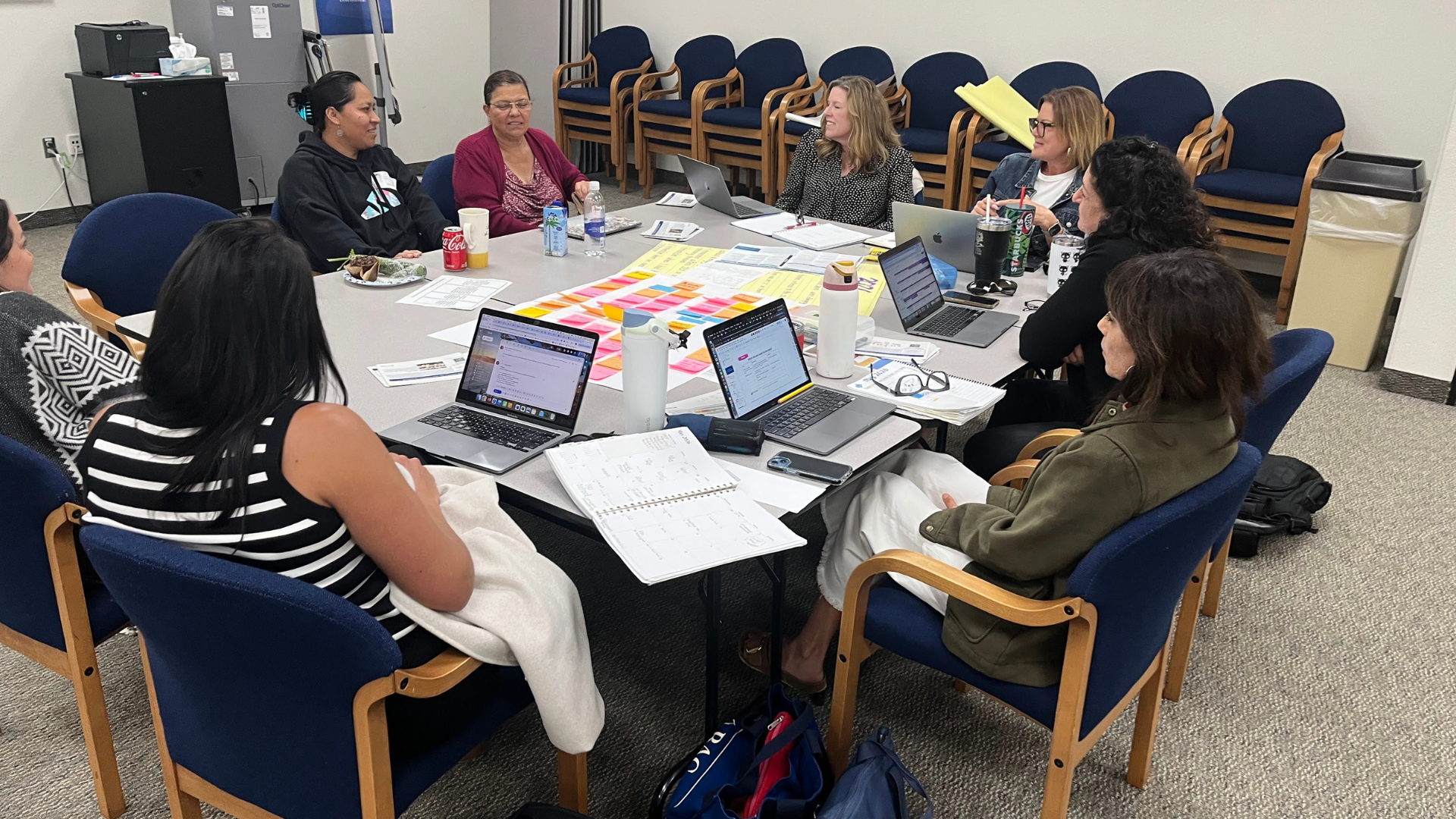
At Miller Elementary (Cohort 3), Amber Fanter held similar excitement. As a former Miller student and current fourth-grade teacher, Fanter saw an opportunity to return to the school’s project-based learning roots she experienced as a child. “I was really excited about redesign…I feel like my teachers back then did a lot of project-based learning, and now, [as a result of the redesign process], I’ve had the opportunity to do that with my students.”
It’s important to elevate Fanter’s comment that she is already trying new things in her classroom. As of this writing, Miller Elementary is still in its first year of the redesign process (academic year 2025-26). To see classroom experiments underway well before a school’s Framework is completed is a reflection of the dynamic nature of EUSD’s School Redesign process.
If this were a rigid, stepwise process, teachers would be instructed to conduct “business as usual” with their learners until their school’s Frameworks were completed. Instead, they are active participants in the Framework’s design, which includes the freedom to take ideas from their design sessions, try them out in their classrooms, and bring back insights that will inform the Framework’s final draft.
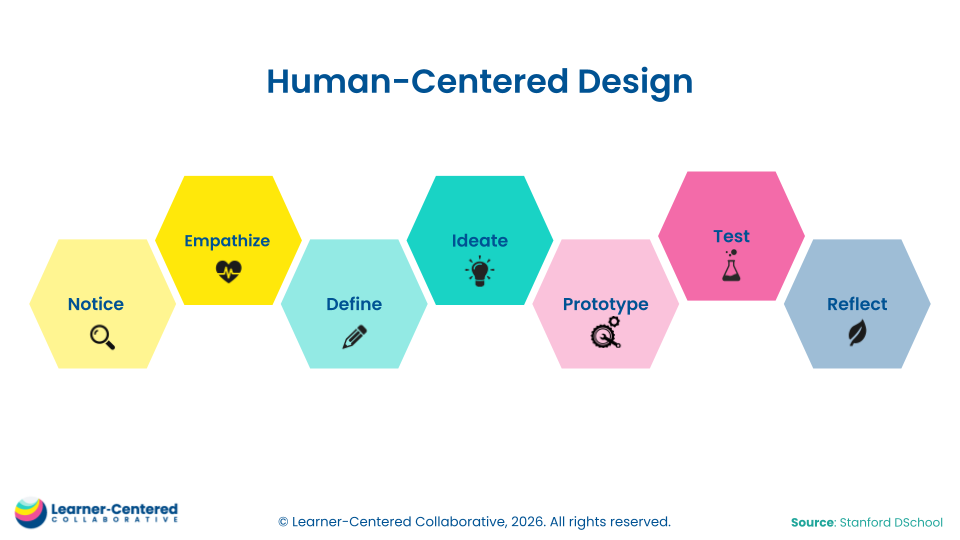
This freedom to experiment is a direct result of the design thinking process that guides Learner-Centered Collaborative’s and EUSD’s School Redesign work. Although the process pictured above might look linear, each area, from Noticing to Reflecting, happens in a “just in time” fashion. For example, a design team might create a Prototype for a solution but realize there is an important question they need to ask the end-user (e.g., a student or family member) before Testing, so they return to the Empathy stage.
Grounding the work in design thinking excited Bo Thomas, eighth-grade science teacher at Mission Middle (Cohort 3). “I’ve been using design thinking in my classroom, so when I found out about [the School Redesign work], I jumped on it…I told my co-teachers this is a once-in-a-lifetime opportunity to do something big.”
When educators are given the opportunity to rethink what school can be, classrooms begin to change. The question, of course, is whether or not that change positively impacts learners.
What’s Changing for Learners
In the early phases of any large-scale redesign effort, the most immediate shifts will first appear in student conversations, the tone of classrooms, and the ways learners see themselves.
At Felicita Elementary, Katie Lyon described noticing a change not just in what students were doing, but in how they carried themselves. Reflecting on her students, she shared, “Bobcats are leaders and public speakers. They care about their community.” For her, redesign surfaced strengths that had always been present but not always activated.
Rather than limiting student voice to isolated classroom moments, redesign efforts created more visible opportunities for participation. Lyon described students stepping forward in ways that extended beyond traditional assignments, emphasizing that they “really can make a difference.” The shift, she suggested, was less about a single project and more about students recognizing that their ideas mattered day in and day out.
“You can see all over campus, these little pockets and opportunities where the students are now owning it… self-driven, self-run, super productive in a positive way.Jody Coe, Escondido Union School District Parent
Parents echoed similar themes.
At Bear Valley Middle School (Cohort 2), parent Jody Coe described noticing visible changes in how students were carrying themselves on campus. “You can see all over campus, these little pockets and opportunities where the students are now owning it… self-driven, self-run, super productive in a positive way.” Rather than simply moving through the school day, she described students stepping into leadership opportunities and taking responsibility for their learning in new ways.
For Jody, the most meaningful shift was a stronger sense of connection. “It feels far more connected…I think they’re far more connected to their classes, to their classwork, because they have more ownership over it.” The changes she initially approached with skepticism began to feel cohesive and intentional, particularly as students leaned into advisory structures and expanded leadership roles across grade levels.
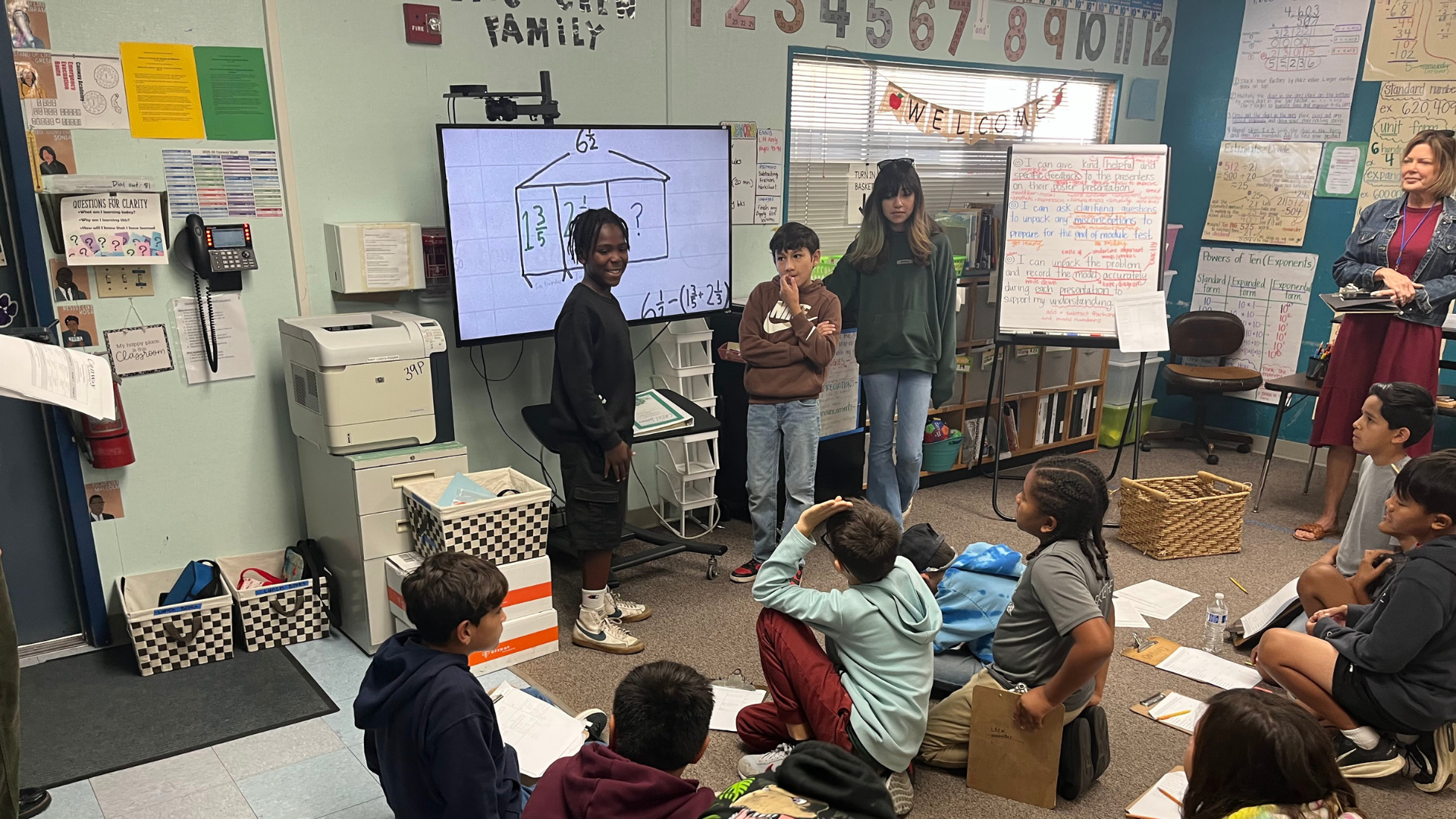
At Rose Elementary (Cohort 2), parent Karina Martinez shared a similar story at a different developmental stage. She described her fourth-grade son rushing home to complete an application for a student leadership role. “He rushed home that day to fill out the application…he was bummed because he didn’t get to start right away.”
For her, that moment reflected something deeper than participation. It signaled that students were not only aware of new opportunities—they wanted to be part of them.
Karina also emphasized how strengthened connections across grade levels have shaped student experience. “Creating that community…not just within their grades… but also with the other grades has definitely been amazing for the students.” As advisory structures and cross-grade groupings expanded, students began seeing themselves as part of a broader learning community rather than confined to a single classroom or age group.
Learn more about building community in the classroom here.
These observations do not claim that redesign has resolved every challenge. What they reflect are early indicators: students stepping forward, seeking out leadership opportunities, expressing pride, and experiencing school as a place where they want to be and have a role to play.
More than two decades of educational research further support these observations, specifically that strong school culture and climate are predictive of educational achievement:
- “Research supports the notion that a positive school climate promotes students’ abilities to learn. A positive school climate promotes cooperative learning, group cohesion, respect, and mutual trust.” —Thapa et al., A Review of School Climate Research (2013)
- “Schools characterized by high-quality interpersonal relationships, communication, cohesiveness, and belongingness between students and teachers are better able to support student psychological needs and promote optimal development in academic domains.” —Wang & Degol, School Climate: A Review of the Construct, Measurement, and Impact on Student Outcomes (2016)
- “Learning is optimized in environments where students feel physically and emotionally safe, experience belonging and purpose, and are supported by strong relationships.” —Darling-Hammond et al., Implications for Educational Practice of the Science of Learning and Development (2019)
These research findings suggest that improvements in culture and climate are not lagging indicators of success; they are leading ones. In Escondido, early signals—particularly at the middle school level—suggest that those conditions are strengthening. On a recent culture and climate survey, middle schools that had begun the redesign process showed higher levels of positive associations in five areas—connectedness, academic motivation, number of caring relationships, perception of high expectations, and meaningful participation—compared to the district’s non-redesign schools.
Influencing Educational Change Across California
As the work deepened inside Escondido classrooms, it also began to extend beyond district boundaries.
In January 2026, the California Collaborative for Educational Excellence (CCEE) launched the state’s Secondary School Redesign Pilot Program. Learner-Centered Collaborative was chosen to lead one of the participating networks and selected EUSD’s Hidden Valley Middle School as the network’s lead demonstration site, noting it as “an emerging model for learner-centered redesign in action.”
Hidden Valley’s interdisciplinary microschool structure, looping advisories, and authentic learning exhibitions are examples of how a coherent learner-centered ecosystem can strengthen belonging, deepen engagement, and improve student outcomes at scale through a School Redesign process.
The CCEE Secondary School Redesign Pilot Program is designed to transform “factory model institutions” into “rich student-centered environments that develop strong relationships, and drive deep learning ready to be applied to complex, real-world challenges.” At the center of the pilot are networks of schools that “operate as demonstration sites” and help “document both the practices that produce success and the barriers that must be addressed for transformation to last and spread.”
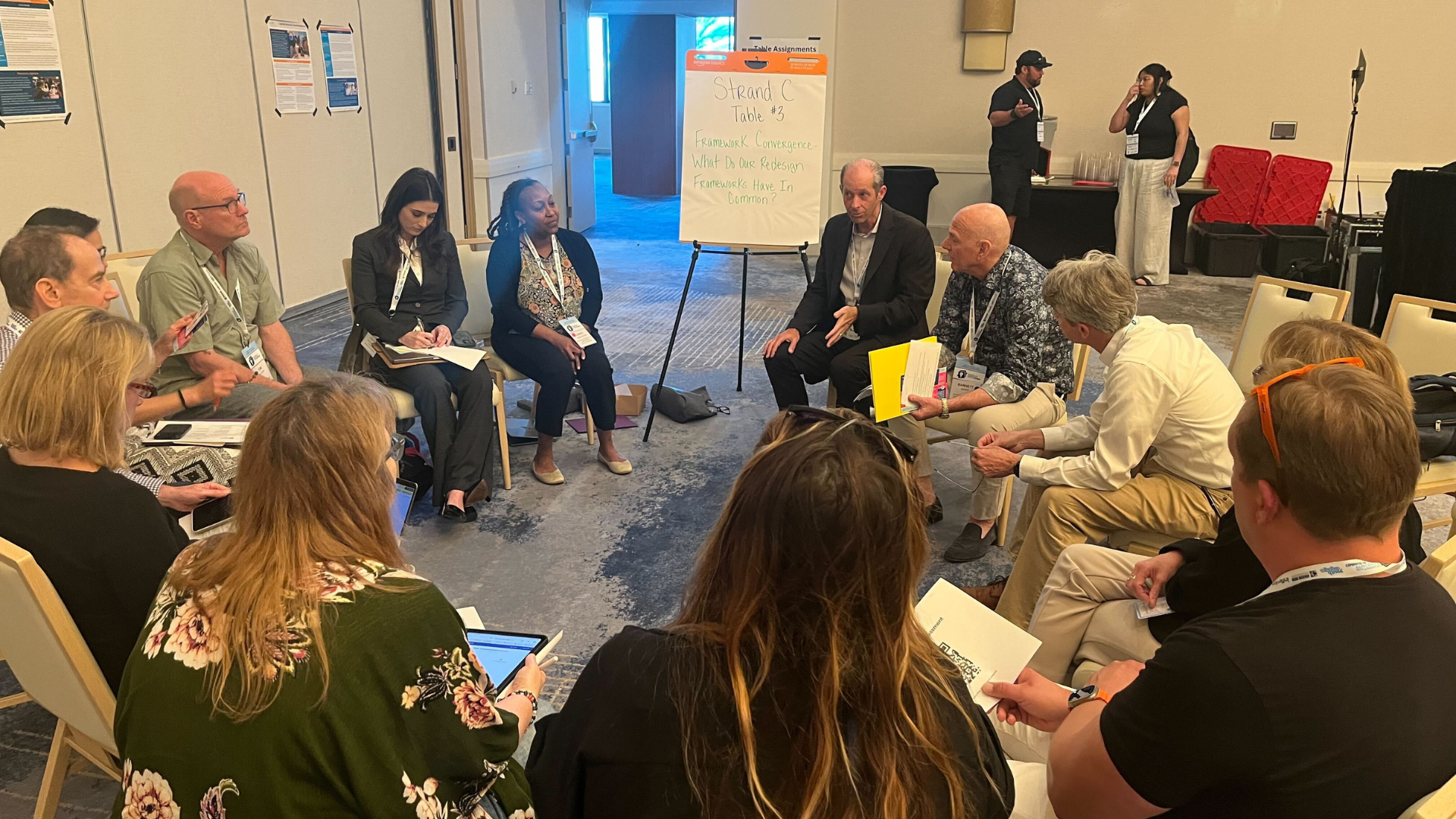
Within this context, Hidden Valley’s role is not to present a finished model, but to serve as a living example of redesign in progress. Through California Network Convenings, school visits, and monthly Communities of Practice focused on competency-based assessment, instructional design, and learner-centered leadership, educators from across the state engage directly with the structures and practices being implemented in Escondido.
Demonstration sites like Hidden Valley showcase redesigned learning environments in which:
- Students are organized into ‘Packs’—small groups where they stay with the same teachers and classmates for multiple years.
- Learning is centered around units that answer essential questions that actually matter in their community.
- Students lead their own exhibitions and conferences where they receive and share feedback—resulting in stronger engagement.
- Schools design sustainable structures to maintain impact over time, including intentional teacher collaboration and distributed leadership.
Participation in the CCEE network situates Escondido within a broader statewide effort to “build capacity, identify promising models, and share best practices statewide.” The pilot will contribute to “statewide learning through peer-to-peer partnerships, documentation of practices, and development of resources applicable across diverse contexts,” with a comprehensive evaluation and legislative report due in 2029.
By hosting site visits, participating in Communities of Practice, and openly documenting progress and challenges, Escondido is surfacing the structural conditions necessary for sustainable change.
Across the country, researchers have noted how difficult it is for promising practices to spread beyond individual classrooms or campuses. As Rebecca E. Wolfe and Stephen Bowen write in The 74:
“We know that the most scalable and sustainable improvements emerge from the needs and problems that practitioners define and from the solutions they help develop. Yet, as a recent research study finds, it remains ‘very rare for an innovation to get diffused within a school, and it is much rarer that it gets diffused between schools.’”
Escondido’s phased, cohort-based redesign — now connected to a statewide network through the CCEE Secondary School Redesign Pilot — represents an intentional effort to address that diffusion challenge. Rather than relying on isolated innovation, the district is building shared structures, documentation practices, and cross-site learning communities designed to help promising practices spread and endure.
Looking Ahead
If the first years of redesign have been about building momentum, the years ahead will be about sustaining and deepening it.
The early signals—particularly at the middle school level—suggest that when collaboration time is protected, leadership is coherent, and learner-centered priorities remain visible, meaningful progress follows. The task at this stage is to protect and refine the conditions that made that progress possible.
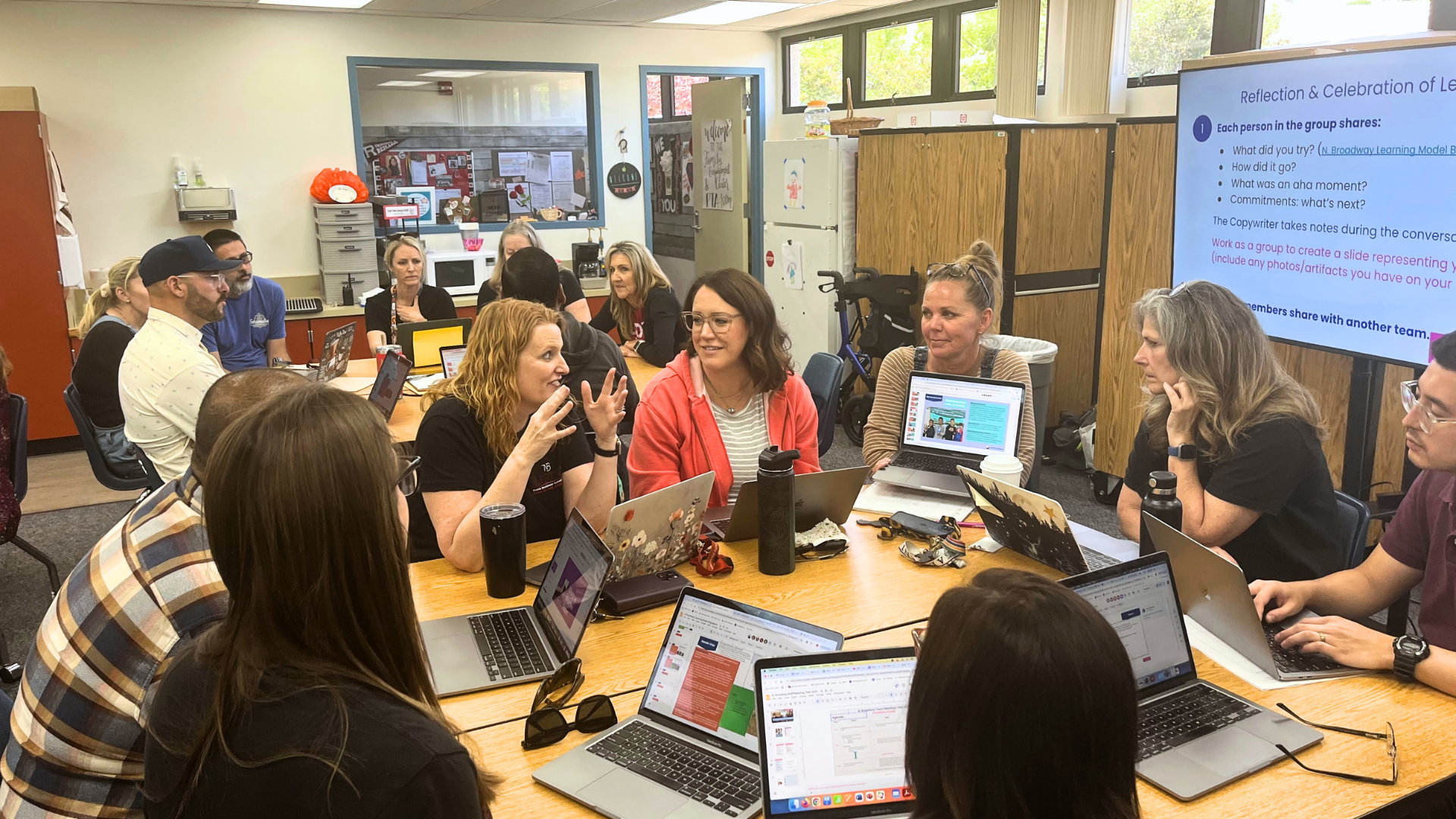
For EUSD, this next phase centers on three commitments.
- Protect the enabling conditions. School Redesign does not sustain itself through inspiration alone. It depends on structural commitments like protected collaboration time for educators, aligned district priorities, thoughtful pacing of initiatives, and leadership continuity. As staffing changes and new pressures emerge, maintaining clarity of direction will be essential. As Cherry Moore reflected when advising future cohorts, “Start with small enough goals that everybody’s willing to take a step. Because if you make goals that are too big, or if you force everybody to go too fast, I think you’ll get your early adopters and innovative teachers way out in front and everybody else too far behind.” Sustaining momentum, she noted, requires keeping “your team together, while meaningfully moving forward.”
- Define and communicate the roadmap. School Redesign is a multi-year journey with five distinct cohorts of schools at varying stages of the process. Clear articulation of implementation phases, leading indicators, and reasonable timelines for academic impact will help manage expectations while reinforcing accountability.
- Track impact over multiple years. Monitoring culture and climate indicators and academic measures over a long time horizon will allow district leaders to understand where acceleration is occurring and where additional support is needed. This long view is especially important as elementary cohorts mature and students experience redesign across multiple grade levels.
At the school level, leaders are already iterating. Hidden Valley continues refining its microschool model and competency-based practices, spreading what is working across the entire school and consistently testing new ideas. Elementary campuses are expanding cross-grade experiences, learner exhibitions, and family engagement structures. Across sites, educators are asking deeper questions about assessment, agency, and the integration of whole-learner outcomes into daily instruction.
That spirit of disciplined experimentation has been visible in classrooms. One teacher, initially hesitant about moving learning outdoors (an agreed-upon design shift at North Broadway Elementary), later told Moore, “she didn’t think the outdoor classroom was going to work.” After trying it with her students, she returned “so excited”—a small risk that reinforced what redesign makes possible when educators are supported to try, reflect, and try again.
It may also be that redesign is beginning to influence how the district approaches change itself. Rather than creating isolated initiatives, there are emerging signs that leaders are asking more explicitly: Does this align with our learner profile? Does it strengthen our learning model? Does it build the culture and climate that research suggests matter most?
That discipline—of returning again and again to a shared vision—may prove to be the most significant outcome of all.
The work in Escondido is evolving. The early years have demonstrated that when adults align around a clear purpose, protect the conditions for collaboration, and center learners in every decision, meaningful change is measurable, sustainable, and worthy of continued investment.
We want to give a special shout out to everyone in the Escondido USD community who made this story possible. First, we want to thank the educators and parents who participated in interviews during a very busy time of year. Second, we want to thank the school communities—from students and families to educators and staff—who are doing the hard work of redesign every day. Last but not least, we want to thank Cherry Moore, who coordinated countless schedules to give the Learner-Centered Collaborative team everything they needed and more to produce this story. It’s been a joy working with this community as partners in redesign work, and we’re grateful for the district’s long-term commitment to learner-centered change. If you’d like to learn more about how to make this type of change happen in your community, connect with the Learner-Centered Collaborative team here.