Competency-Based Reporting Playbook
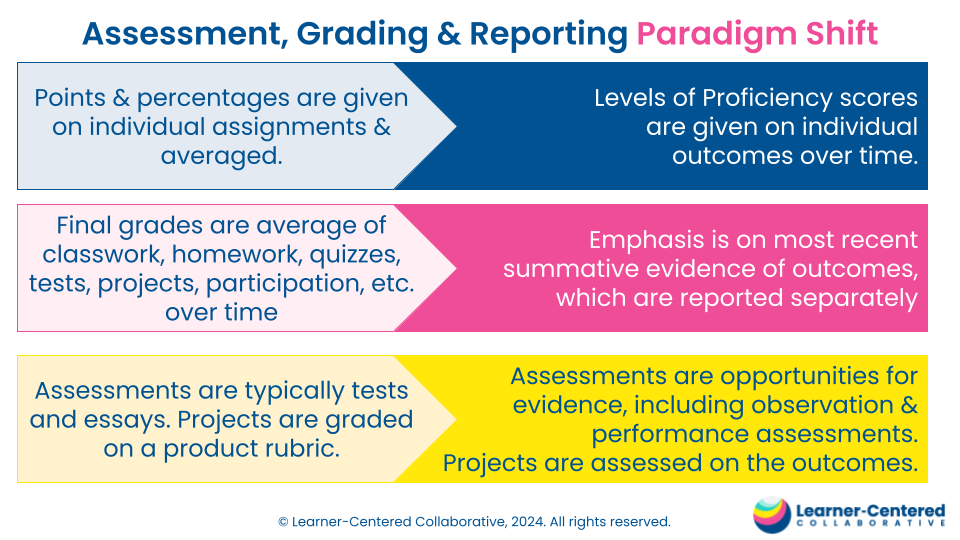
Welcome to the Learner-Centered Collaborative’s Playbook on Competency-Based Assessment, Grading and Reporting. In many traditional grading systems, learners are ranked, sorted and seen as a number in a gradebook. But there’s a competency-based world in which learners can be valued for who they are and how they are growing as individuals. It’s time for a paradigm shift from a traditional to a competency-based approach to assessment, grading and reporting.
This resource illuminates what is often a black box – how schools and districts are shifting away from traditional grading practices to ones that better align with and support learner-centered, competency-based education. Through interviews with dozens of schools and districts at various stages of implementing competency-based practices, along with insights from supporting organizations and edtech providers, we’ve compiled key learnings, models, and guidance to help your system thoughtfully approach the adaptive and technical changes involved in redesigning your assessment and reporting structures.
While assessment and grading is just one piece of the larger shift to learner-centered education, it is often a sticking point, with traditional practices living in tension with the overall vision. By making the alternatives concrete and visible, we hope to support your community in moving forward with changes that enable authentic, personalized, equitable and inclusive learning experiences for all.
This Playbook includes three main sections:
Part 1: Introduction
- Explore the challenges with traditional grading and reporting
- Understand the shifts involved in moving to a competency-based approach
- Discover the impact these changes can have on learners, families and educators
- Learn key terminology and foundational concepts
Part 2: Designing Competency-Based Assessment and Reporting Structures
- Dive into the key decisions and considerations involved in creating a new system
- Learn how to identify outcomes, define proficiency levels, establish evidence, summarize progress, and more
Part 3: Explore Competency-Based Reporting in Action
- See real-world examples from a diverse range of schools and districts
- Learn how they have implemented competency-based practices in their unique contexts
Please complete the form below to access the playbook.