Now is the Time for Systemic Coherence: Reflections on the 25-26 Academic Year
I’ve been going through this year’s Bright Spots, and I keep coming back to the same line of thought. As educators, we know what works. We know what we want our classrooms and schools to be like. We know what purposeful learning feels like. And, I am so grateful to the brave communities who are working together to build the new structures and systems that align what we know with the research on learning, development, and change management to create new and better opportunities for the learners they serve.
At Learner-Centered Collaborative, we’ve seen the real moments—in classrooms, in design sessions, on trips, in conversations—that point to what’s possible when we center learners by design.
As we continue leaning in to learner-centered change, we must navigate the challenges and opportunities of our modern world: decisions on screentime, how AI tools are changing how we live, work, and learn, and ensuring belonging, joy, and academic success are not tradeoffs but the core of how schools are designed. To navigate this world effectively, the following themes stood out to me throughout the year.
Young People Rise When Conditions Are Right
I saw this over and over again this year, but taking students abroad to Spain made it impossible to ignore.
Watching students navigate a completely new country—figuring out transportation, managing time, making decisions, supporting each other—it was clear they were capable of far more than we typically give them credit for. Not because someone told them what to do, but because the situation required them to step up.
That same pattern showed up in a completely different way during the Liftoff design sprints. When we invited students to give feedback and actually shape the work, they didn’t hold back. They pushed on ideas, named what wasn’t working, and influenced adult thinking in real ways.
And then there were the elementary classrooms in Del Mar, Cardiff, Hampton Township—some of my favorite Bright Spots of the year—where you could feel the difference immediately. Students weren’t just compliant or “on task.” They had ownership. They were making choices, talking about their learning, and showing joy in a way that’s hard to fake.
Different contexts. Same underlying truth: when we create the right conditions—trust, responsibility, real work—young people rise.
It makes you question how many of the limits we see are actually ours, not theirs.
Read More: Why Mindset Matters in Cultivating Learner-Centered Change
Redesign Requires New Systems and Structures
For too long, innovation has depended on heroic educators—teachers and leaders who navigate around constraints, make an impact despite the system, or quietly push boundaries just to create the learning experiences they know students deserve.
But real transformation can’t rely on workarounds.
What’s encouraging right now is the growing momentum to move beyond that—to redesign the systems themselves.
In California, the Secondary School Redesign Pilot is an important signal. Schools and districts aren’t just being asked to improve outcomes; they’re coming together to explore what’s working, what’s challenging, and what’s possible when we rethink the structures that shape learning.
We saw a similar shift during the Liftoff Design Sprint. Bringing together leaders, young people, technologists, and experts in learning and human development created space not just for ideas, but for tangible models to emerge. The experience didn’t just shape the thinking of those in the room—it produced examples that can inspire and inform others.
Across the microschool teams we’ve been supporting, this mindset is even more pronounced. These teams aren’t trying to refine the traditional model; they’re building something fundamentally different. Schedules, roles, and learning experiences are being intentionally designed around learners, rather than asking learners to fit into existing systems.
That’s the shift: from hacking the system to designing one that actually works.
Read More: Public Microschools as an On-Ramp to Systemic School Redesign
Measure What Actually Matters
The Hawai’i scorecard work keeps coming up for me because it sits right at the intersection of vision and reality.
It’s one thing to say we care about things like belonging, purpose, or real-world readiness. It’s another thing to actually try to measure them in ways that are meaningful and usable.
What I’ve appreciated most is that this isn’t just a technical exercise—it’s a values conversation. Communities are being clear about what they want for their young people, and then building systems that reflect that.
You can see that same shift in student showcases. When students are presenting their learning—explaining their thinking, reflecting on their growth, sharing work that matters—you get a completely different picture than you would from a test score.
It doesn’t mean traditional measures disappear. But they stop being the only story.
And over time, that changes everything.
Explore our Classroom Strategies for ideas on learner-centered assessment practices.
Adult Learning and Growth Matters Too
One thing that grounds this work is that educators create what they experience.
If we want classrooms that are engaging, collaborative, and centered on deep learning, then the environments we create for adults have to reflect those same qualities. Adult learning isn’t separate from system change—it is the driver of it.
In the cohort work like SoCal LiNK, a research practice partnership, I’ve watched leaders get sharper at articulating what they’re trying to do, why it matters, and highlighting the impact. That clarity doesn’t stay contained—it shapes decisions, priorities, and ultimately the experiences learners have every day.
I’ve seen educators open up their practice, learn from one another, try new approaches, and refine in real time—not because they’re being directed to, but because they’re experiencing learning in ways that feel meaningful and aligned to the kind of classrooms they want to create.
And just as important, there’s been more intentional space to recognize and celebrate that growth for all learners, not just the students. When educators experience the kind of learning we hope to see for young people—collaborative, purposeful, reflective, and evolving—their practice changes.
Where We’re Headed
If this year clarified anything, it’s this: the future of learning isn’t going to be shaped by swinging between extremes.
It’s not about choosing AI or no AI. Screens or no screens. Nature or academics. Belonging or rigor.
Those debates oversimplify the real work.
What I see emerging instead is a more disciplined and intentional approach—one that starts with clear goals and desired outcomes for young people, and then makes thoughtful decisions about how to design systems that actually deliver on them.
The most promising work isn’t driven by mandates or trends. It’s grounded. It’s informed by what we know from research and practice about how people learn, how they develop, and what leads to deep, meaningful, and lasting learning.
Read more about what drives learner-centered change in communities like yours by downloading “A Learner-Centered Ecosystem” by Dr. Katie Martin.
It’s also contextual. What works in one place might look different in another—and that’s not a problem, it’s the point.
So rather than chasing the next big idea or reacting to the latest pressure, the shift I see is toward coherence:
- Being clear about what we value
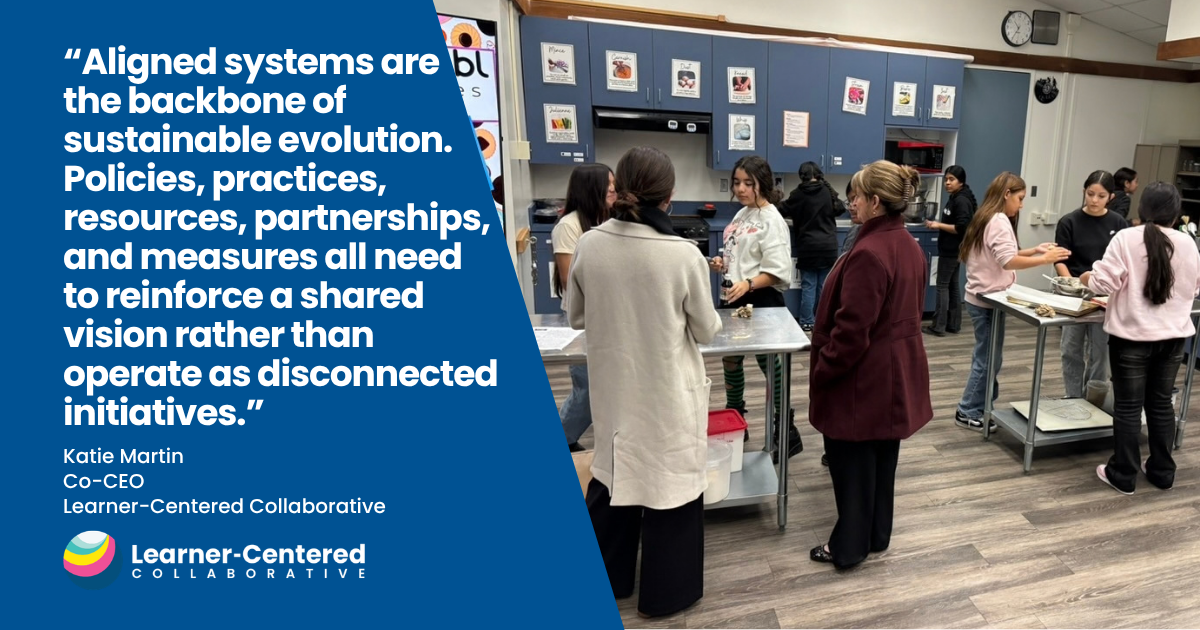
- Aligning experiences, structures, and measures to those values
- And continuously learning and adjusting along the way
That kind of work is slower. It’s more complex. It requires expertise, contextual knowledge, and critical thinking, not just compliance.
But it’s also what gives me the most confidence.
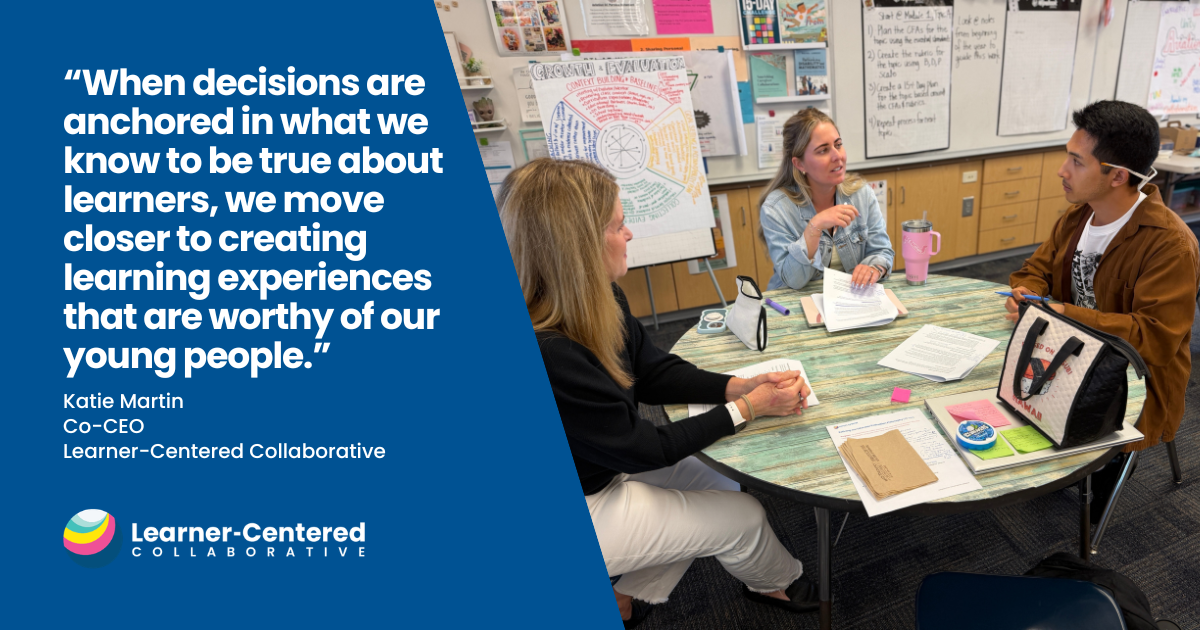
Because when decisions are anchored in what we know to be true about learners—and when systems are intentionally designed instead of inherited—we move closer to creating learning experiences that are worthy of our young people.
And that feels like the direction that matters most.
If your school or district believes this is the direction that’s best for your community, reach out to our team to learn more about how we can support your journey.