Building a Public Education System That Learns, Adapts, and Endures
In 1972, Kodak Research Labs began experimenting with digital photography. By 1975, they had their first battery-powered digital camera prototype. Four years later, a Kodak employee predicted digital photography would be ubiquitous by 2010.
Kodak filed for bankruptcy in 2012. What happened and what can education leaders learn from Kodak’s unexpected collapse?

Kodak share price from 1965-2012. Graphic by Quartr, featured in Edge #62.
When that first digital camera was presented to Kodak leadership, they were impressed by the innovation but couldn’t see the business advantage. The upfront investment would be large, early demand would be low, and there were computer hardware companies better positioned to take advantage of this technology.
For decades, Kodak had built a stronghold in film and the chemicals needed to produce and process it. A digital photograph made those products obsolete. They were working on NASA missions, collaborating with the CIA, and annual sales had reached $2 billion by 1966. There was no reason to pivot with such high demand for their products.
They continued making small investments in digital technology throughout the remainder of the 20th century, but by the time the company fully embraced it, the opportunity was gone.
Kodak invented the future but prioritized protecting the past and eventually found itself on the sidelines. This is not simply a story about technology. It is a story about leadership and about the choices organizations make when faced with moments of profound change.
Kodak did not fail because it lacked innovation. It failed because it did not act on the innovation it already possessed.
Education Is Facing Its Own Kodak Moment
Public education today is facing a similar moment and on an eerily similar timeline. The Kodak name was trademarked in 1892, the same year the Committee of Ten was formed by the National Education Association, which set the foundation for many of the school-centered systems and structures we’re most familiar with today—teaching subjects in silos, measuring learning based on seat time, grouping learners in age-based cohorts.
Across the country, there is a growing recognition that the conditions surrounding public education are shifting in significant ways, and the system’s core features are becoming more and more irrelevant to what the world demands.
Artificial intelligence is transforming how knowledge is accessed and applied. 40 states are projected to see public school enrollment declines over the next five years, compounding the declines already seen in the first half of the 2020s. Local, state, and federal budget pressures are forcing systems to make difficult decisions about how to allocate limited resources. One in eight teaching positions is either unfilled or filled by a teacher who is not fully certified for the role. And, industry continues to report significant readiness gaps with entry-level employees.
For decades, we have talked about the need to evolve, but most systemic changes have been minor improvements on the original design. Meanwhile, communities have been independently testing and iterating bold ideas on the fringes, showcasing previously unimagined possibilities.
If we looked at all education efforts—public, private, independent, and otherwise—under a unified umbrella, these experiments are like the innovations that were happening within Kodak Research Labs. And, just like Kodak’s digital camera prototype, we have already invented what the future is calling for—an intentional redesign of public education such that every learner knows who they are, thrives in community, and actively engages in the world as their best selves.
The question is whether or not we’ll stick with what’s familiar and what the school-centered system has been built to support, or if we’ll be willing to shift. Kodak is a cautionary tale about what happens when we rest on our laurels, but there are numerous examples of the opposite story.
Read More: Why Mindset Matters in Cultivating Learner-Centered Change
Public Education Must Evolve to Honor Its Purpose
After dominating the personal computing era, Microsoft initially underestimated the significance of the internet. Over time, the company made deliberate shifts, investing in cloud infrastructure, expanding into new markets, and rethinking its role in a rapidly evolving landscape. Netflix began as a DVD rental-by-mail service and is now a streaming giant with movies and shows earning accolades at Hollywood award shows.
These organizations did not abandon their purpose. They expanded it. They treated change as an opportunity to learn and evolve. Public education can do the same.
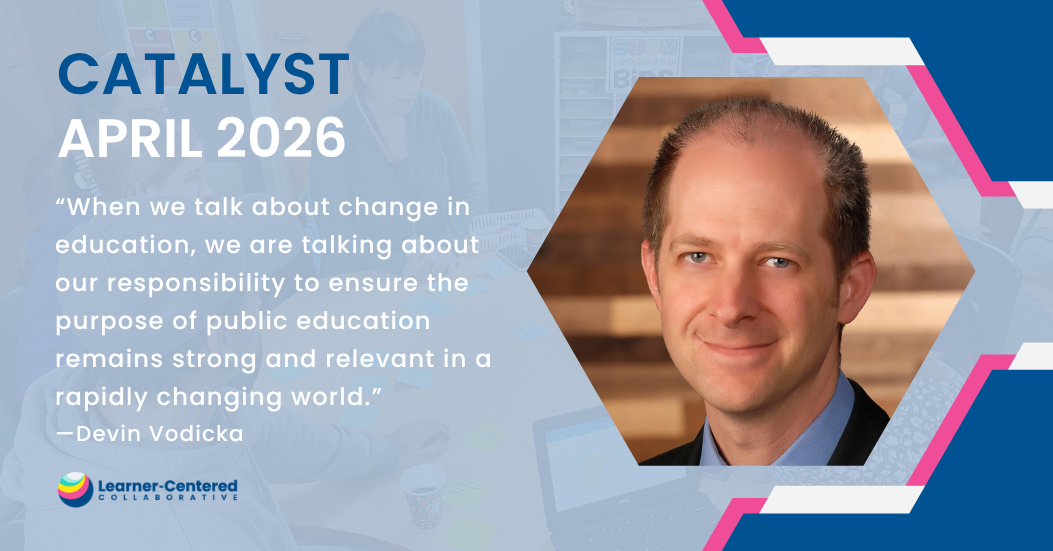
Public education serves a public purpose. It is one of the few systems designed to serve all learners, strengthen communities, and contribute to a healthy and functioning democracy. When we talk about change in education, we are talking about our responsibility to ensure that this public purpose remains strong and relevant in a rapidly changing world.
If public education does not evolve to meet the needs of learners and families, others will fill that space. Homeschooling, for example, spiked 39% during the COVID-19 pandemic, and saw only a slight decline before increasing again in the following years. Educational alternatives may offer innovation and flexibility, but they may not always reflect the same commitment to equitable access and community that defines the public system.
This moment, therefore, is not only about responding to disruption. It is about reaffirming and strengthening the role of public education in society, which will require a commitment to rigorous research and development.
Public Systems Need Local Research and Development
At Hidden Valley Middle School in Escondido, educators created a microschool within their existing campus as a way to explore new approaches to learning. This included a focus on advisory and wellness structures, interdisciplinary project-based learning, and stronger relationships between students and adults. The intention was to establish a space where new ideas could be tested, refined, and eventually expanded across the broader school community. Since launching, innovative ideas from the microschool have been scaled across grades 7-8, impacting even more learners.
This approach reflects a deeper principle about how organizations learn, and it points to an area where education systems have a significant opportunity to grow.
If we aspire to be learning organizations, we must be intentional about how we design for learning at the system level. This is where research and development becomes essential. In many industries, R&D is not an optional function. Again, it’s how Kodak invented the digital camera in the first place. R&D is a core strategy for navigating uncertainty and staying relevant over time.
In education, we have often treated innovation as a series of isolated initiatives rather than as an embedded capability. Microschools, pilot programs, and emerging approaches such as AI-enabled learning environments can serve as R&D spaces within our systems. They allow us to test ideas, generate evidence, and build confidence before scaling. They also create opportunities for educators, leaders, and communities to engage in the kind of continuous learning that we seek to cultivate for students.
Read More: Leading at the Edge: Navigating Uncertainty With a Local R&D Strategy
Uncertain Times Create a World of Possibilities
Jim Collins, in his research on organizations that thrive in uncertain environments, describes the importance of disciplined progress over time. He refers to this as the 20-Mile March, emphasizing the value of consistent, steady movement toward a clear set of priorities. He also highlights the concept of “bullets before cannonballs,” encouraging leaders to test ideas through small, low-risk experiments before making large-scale investments.
These ideas align closely with an R&D mindset. They remind us that evolution is not the result of a single bold move, but of a series of intentional steps that build momentum and clarity over time.
One of the most common questions that emerges in conversations with leaders is whether moving too quickly might create unintended consequences. It is a thoughtful and important concern. At the same time, the greater risk may lie in moving too slowly. When the environment around us is changing, delay can compound challenges and narrow the range of options available to us in the future.
The challenges education leaders face today are real, but so are the opportunities. Across the country, there are districts and schools that are leaning into this moment. They are designing learner-centered models, strengthening connections with their communities, and creating experiences that are more relevant and engaging for students. These efforts are indicators of what is possible when systems commit to learning and evolving in response to changing conditions.
We do not get to choose whether education will change. That change is already underway. What we do get to choose is how we respond. For leaders who are asking what this means in practice, a few starting points can help translate intention into action:
- Identify one or two priority areas where your system needs to learn and evolve, and commit to steady progress over time.
- Create a space for disciplined experimentation, such as a pilot program or microschool, that allows your team to test new approaches and generate evidence.
- Establish a cross-functional group of educators, leaders, and community members to guide this work.
- Create communication structures that enable learnings to be widely shared across the learning community.
These steps are not about launching new initiatives for their own sake. They are about building the capacity of your system to learn, adapt, and lead, no matter what disruptions come next.
This is a defining moment for education. It calls for leadership that is both courageous and deeply committed to the role that public education plays in shaping the future of our communities. We can and must lean in.