Writing a New Chapter in Educational Leadership
With each passing day, the challenges educational leaders face have fewer and fewer straightforward solutions. The leadership handbook is being rewritten, requiring a shift in mindset, behavior, and identity.
Many of the structures and systems in education were built to solve predictable problems. Originally, the aim was to develop an educated citizenry capable of contributing to an industrial economy running on closed-loop, linear processes. So, we created an education system that mirrored this linear design, with “best practices” clear and complexity a rarity.
Today’s most pressing challenges—artificial intelligence, student mental health, workforce shifts, political polarization, climate uncertainty—do not respond to linear plans or compliance-driven implementation. They are adaptive in nature. They evolve as we engage them.
If you’ve been in education at any level for some time, you can feel this tension. The strategies that once produced traction now create friction, and feeling effective is more difficult than ever before. To meet this moment, we must shift our mindset, adjust our behavior, and ultimately reimagine our identity as leaders.
Shifting Mindset: From Certainty to Curiosity
The first shift is internal.
Much of traditional leadership training prepares us to diagnose problems and deliver solutions. This mostly works when the challenge is technical, or when the problem is clear, and the solution is known. In those cases, process and expertise are powerful tools.
But many of the challenges we now face are adaptive (as distinguished by Heifetz and Laurie). These are challenges for which there are no clear answers, and the questions themselves benefit from exploration and clarity. Adaptive challenges require experimentation and discovery, and the people closest to the challenge must “do the work of solving it.”
If you’ve ever had the experience of launching a new program or initiative (with great excitement and belief) only to see its intended outcomes fail to materialize, you may have tried to solve an adaptive challenge with a technical solution. “Best practices” simply don’t apply here. We have to go through an entirely different process to create something that works, which first requires an entirely different mindset.
Read More: Why Mindset Matters in Cultivating Learner-Centered Change
At the heart of this shift is a humbling realization: we have never had control in the first place. In more stable environments, it may have felt like control. Clear rules, defined schedules, and established routines create the appearance of alignment. But we have always been working with human beings—learners and adults alike—who possess their own agency. Leadership, at its core, has always been about influence, not authority.
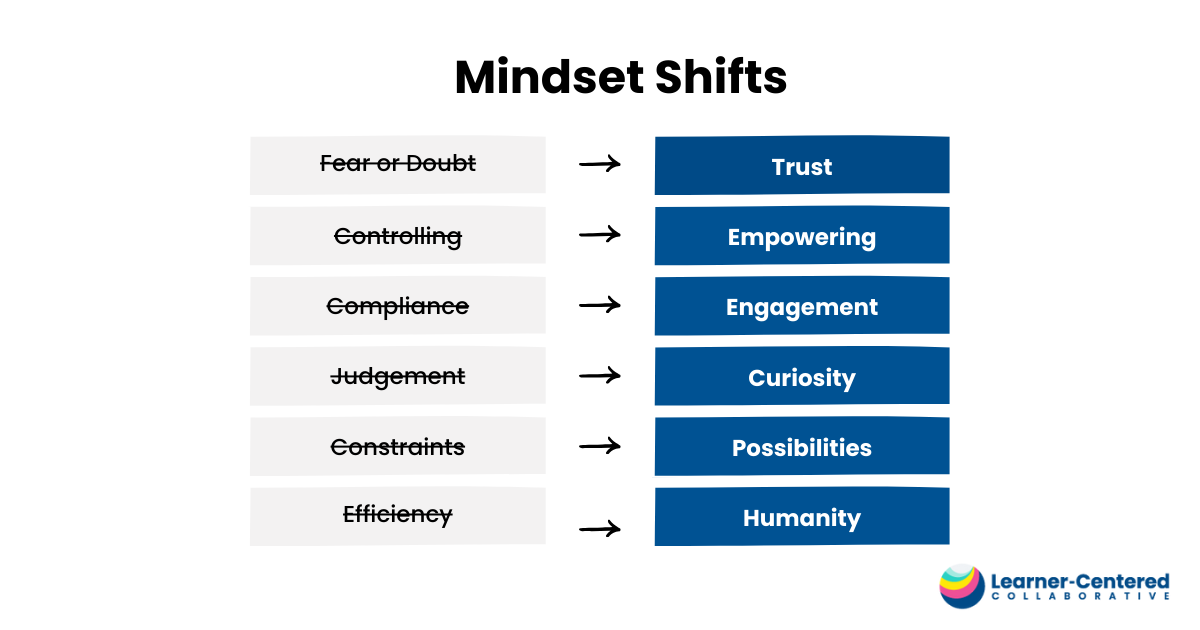
When we acknowledge this, our questions change. Instead of asking, “How do we ensure compliance?” we begin asking, “How do we invite ownership?” Instead of assuming resistance, we look for insight. Instead of rushing to closure, we stay in inquiry long enough for deeper understanding to emerge.
Artificial intelligence only heightens this reality. The technical barriers that once limited innovation are dissolving. What used to require large teams and significant funding can now be prototyped quickly. This is an enormous opportunity, and having a learner-centered mindset that distributes leadership and sees each adaptive challenge as a call to engage in deep partnership with all relevant stakeholders will enable leaders to succeed.
Adjusting Behavior: From Directing Solutions to Designing With Community
A new mindset must translate into new behaviors.
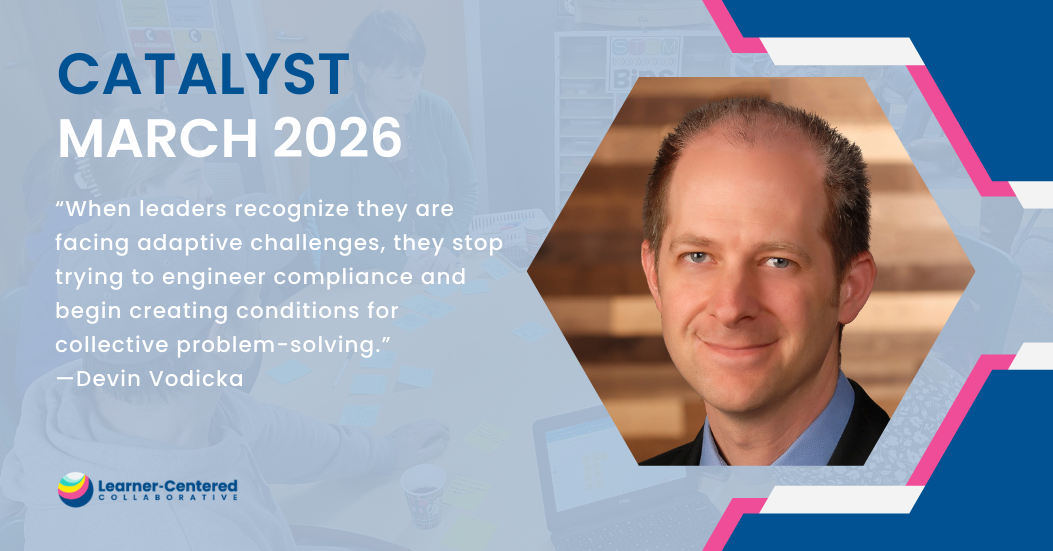
When leaders recognize they are facing adaptive challenges, they stop trying to engineer compliance and begin creating conditions for collective problem-solving.
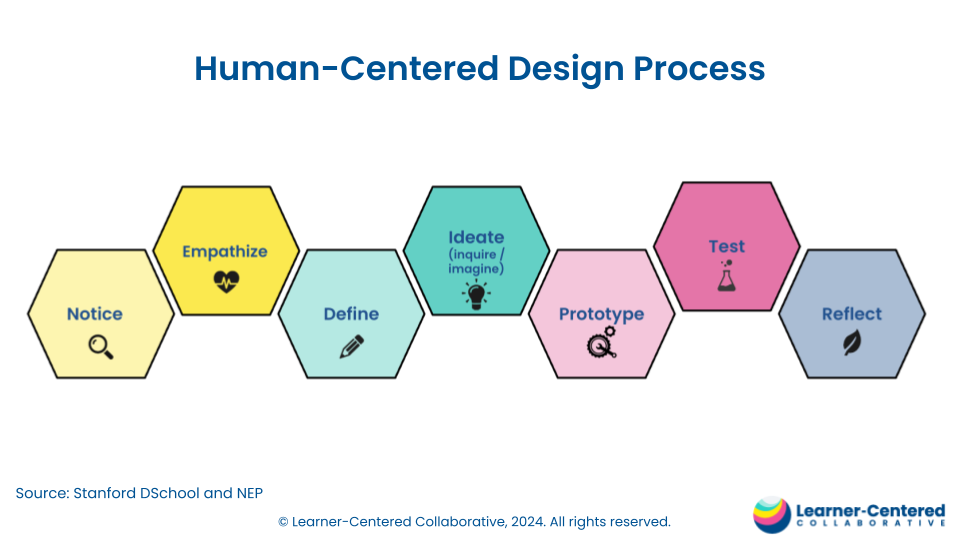
First, we take notice of what challenges might be present and practice deep empathy. We engage those most affected by the challenge, including students. We empathize and learn what they think by exploring what they experience. What happened? How did that feel? What do you wish was different about that experience? We continue listening until we no longer hear new insights. And just in case we mistakenly think we’ve heard everything there is to hear, we ask each person, “Who else should we talk to?”
Second, we ideate and prototype. We take the insights we gathered, define the challenge, and create a team (including people most impacted by the challenge) to ideate a solution. Rather than bolting solutions into place, we test small ideas in real contexts. We learn quickly. We adjust. We iterate. Perfection is not the goal. Finding the smallest unit of change and testing it, gathering thoughtful feedback, and creating an elegant solution that can adapt to future shifts is what we are aiming for.
Third, we make learning visible. We name what we are testing. We share what we are discovering. We treat implementation not as a rollout, but as an experiment designed to improve outcomes for learners.
These behaviors can feel unfamiliar in systems conditioned for top-down decision-making, yet they are essential in today’s complex educational environments. They distribute ownership. They build relational trust. They expand the field of possibility. When practiced consistently, these behaviors begin to reshape the culture of a system.
Claiming a New Identity: From Manager of Change to Steward of Learning
We’ve discussed shifting to a learner-centered mindset, adjusting behaviors when solving adaptive challenges, and now it’s time to explore claiming a new identity as leaders.
Today’s educational leaders must see themselves as stewards of learning at the system level, where research and development are embedded in daily practice. Leaders should be asking, “What evidence are we seeing?” “What patterns are emerging?” “What is this telling us about our learners and our system?” We must measure what matters, not what’s convenient.
In more stable eras, leaders could primarily see themselves as managers of improvement—responsible for setting direction, aligning initiatives, and ensuring execution. Progress was often defined by fidelity to a plan. In adaptive times, that definition is too narrow.
To steward learning at the system level means creating the conditions where inquiry is continuous. It means treating new initiatives as hypotheses rather than mandates and normalizing reflection as much as action.
When research and development are embedded in daily practice, classrooms become sites of disciplined experimentation. Leadership teams become learning teams. Data conversations shift from proving success to improving impact.
This identity also requires courage. Measuring what matters often challenges legacy metrics and long-standing assumptions. It may mean elevating learner agency, belonging, and deeper learning alongside traditional indicators. It may mean revisiting report cards, transcripts, and scorecards so that they reflect growth over time rather than isolated snapshots.
Most importantly, it requires humility. Stewards of learning do not pretend to have all the answers. They take responsibility for ensuring the system is asking better questions.
When leaders claim this identity, coherence strengthens. Vision and values are no longer slogans; they become criteria for evidence. Decisions are not driven by urgency alone, but by insight. Over time, the system does what we hope our learners will do—it learns.
It’s Time for a New Chapter
The educational leadership handbook is evolving. Structure still matters. Vision still matters. Coherence still matters. But the way we pursue them must reflect the complexity of the world our learners are inheriting.
There is an opportunity to embrace a new mindset, embody new behaviors, and step into a renewed identity as leaders. In doing so, we move closer to co-creating educational ecosystems where all learners know who they are, thrive in community, and actively engage in the world as their best selves.
The question is not whether the handbook is being rewritten. The question is how we will choose to author the next chapter.